
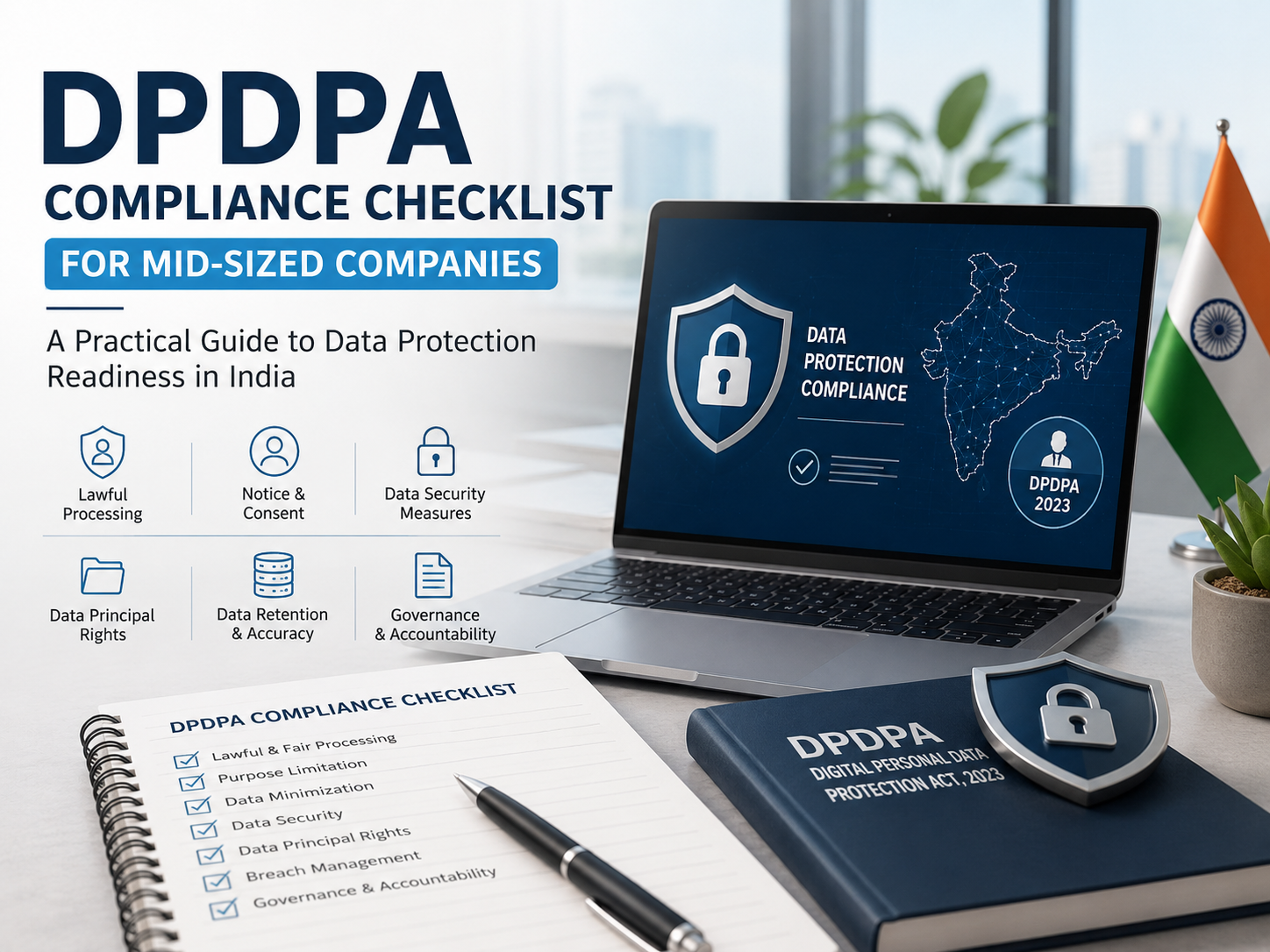
In today’s digital-first business environment, data has become one of the most valuable assets for organizations across industries. From customer information and employee records to financial transactions and operational data, businesses are continuously collecting, storing, and processing sensitive information. With the introduction of the Digital Personal Data Protection Act (DPDPA), Indian businesses are now expected to adopt stronger privacy practices, implement cybersecurity measures, and ensure responsible data handling across all departments.
For mid-sized companies, DPDPA compliance is no longer optional. Organizations that fail to protect personal data may face operational disruptions, reputational damage, legal consequences, and financial penalties. At the same time, businesses that proactively strengthen their data protection frameworks gain customer trust, improve governance, and create a more secure digital ecosystem.
This blog provides a comprehensive DPDPA compliance checklist for mid-sized companies, helping organizations understand the essential steps required to meet regulatory expectations while improving cybersecurity resilience and operational efficiency.
Understanding the Digital Personal Data Protection Act (DPDPA)
The Digital Personal Data Protection Act is India’s data privacy regulation designed to govern how organizations collect, process, store, and protect personal data. The law applies to businesses handling digital personal data within India and also impacts organizations processing data related to Indian citizens.
The primary objective of the DPDPA is to ensure that businesses manage personal information responsibly while giving individuals greater control over their personal data. The regulation emphasizes transparency, consent management, data minimization, purpose limitation, security safeguards, breach notification, and accountability.
For mid-sized companies operating in sectors such as manufacturing, healthcare, education, finance, IT services, retail, renewable energy, logistics, and e-commerce, compliance with DPDPA is becoming a critical business requirement.
Why DPDPA Compliance Matters for Mid-Sized Companies
Many mid-sized organizations assume that data privacy regulations only impact large enterprises. However, cyberattacks increasingly target growing businesses due to weaker security infrastructure and limited governance frameworks. Mid-sized companies often handle large volumes of customer and employee data without having mature cybersecurity systems in place.
DPDPA compliance helps businesses:
Improve customer trust and brand reputation
Strengthen cybersecurity posture
Reduce the risk of data breaches
Enhance operational transparency
Improve third-party vendor security
Support digital transformation initiatives
Minimize regulatory and financial risks
Build secure cloud and IT environments
Enable better governance and accountability
Organizations that implement structured compliance frameworks also become more attractive to enterprise customers, government projects, and international business partnerships.
Complete DPDPA Compliance Checklist for Mid-Sized Companies
Conduct a Data Discovery and Data Mapping Exercise
The first step toward DPDPA compliance is understanding what personal data the organization collects and where it resides. Many businesses store sensitive data across multiple systems including cloud platforms, email servers, CRM applications, HR systems, laptops, databases, and backup environments.
A detailed data mapping exercise helps identify:
Customer personal data
Employee information
Vendor and partner records
Financial and transactional data
Sensitive business information
Cloud-stored personal data
Third-party data processing locations
Data discovery enables organizations to classify sensitive information and implement appropriate security controls.
Establish a Clear Data Privacy Policy
Every organization must create and maintain a comprehensive privacy policy aligned with DPDPA requirements. The privacy policy should clearly explain:
What personal data is collected
Why the data is collected
How the data is processed
How long the data is retained
Who has access to the data
How users can request data deletion or correction
How consent is managed
A transparent privacy policy improves customer confidence and demonstrates accountability.
Implement Consent Management Mechanisms
Under DPDPA, organizations must obtain valid user consent before collecting or processing personal data. Businesses should deploy systems that allow users to:
Provide consent clearly
Withdraw consent easily
Access privacy notices
Review data usage terms
Request deletion of personal information
Consent management platforms play a critical role in maintaining regulatory compliance and audit readiness.
Strengthen Cybersecurity Infrastructure
Strong cybersecurity measures are essential for protecting digital personal data. Mid-sized companies should implement:
Endpoint security solutions
Firewall and network protection
Email security systems
Multi-factor authentication
Identity and access management
Data encryption technologies
Backup and disaster recovery solutions
Security monitoring and incident response systems
Cybersecurity frameworks should align with industry best practices and support continuous risk management.
Deploy Data Backup and Recovery Solutions
Data loss caused by ransomware attacks, insider threats, accidental deletion, or hardware failure can significantly impact business continuity. Mid-sized companies should implement automated backup and recovery solutions to ensure secure data protection.
An effective backup strategy should include:
Cloud backup solutions
Immutable backups
Offsite disaster recovery
Automated backup scheduling
Rapid recovery capabilities
Business continuity planning
Reliable backup infrastructure helps organizations recover quickly while minimizing operational downtime.
Implement Access Control Policies
Not every employee should have unrestricted access to sensitive data. Role-based access control helps organizations reduce internal security risks by limiting data access based on job responsibilities.
Access management should include:
Least privilege access policies
Privileged account monitoring
Password security enforcement
User activity tracking
Identity verification systems
Regular access reviews
Strong access controls significantly reduce insider threats and unauthorized data exposure.
Conduct Vendor Risk Assessments
Many organizations share personal data with third-party vendors, cloud providers, consultants, and external partners. Under DPDPA, businesses remain responsible for ensuring that external vendors also follow proper data protection practices.
Vendor assessments should evaluate:
Cybersecurity maturity
Data storage practices
Cloud security standards
Compliance certifications
Incident response readiness
Third-party access controls
Third-party risk management is becoming a critical component of modern cybersecurity governance.
Develop a Data Retention and Deletion Policy
Organizations should avoid storing personal data longer than necessary. DPDPA emphasizes responsible data retention and secure disposal practices.
A proper data retention policy should define:
Retention timelines
Archival procedures
Secure deletion methods
Backup retention periods
Data disposal workflows
Automated retention management systems can help businesses reduce compliance risks while optimizing storage costs.

Establish a Data Breach Response Plan
Cybersecurity incidents can occur despite preventive measures. Mid-sized companies must prepare for potential data breaches through structured incident response planning.
A breach response plan should include:
Incident detection procedures
Internal escalation processes
Forensic investigation steps
Data breach notification workflows
Regulatory reporting processes
Customer communication guidelines
Recovery and remediation actions
Rapid incident response helps minimize business disruption and regulatory exposure.
Conduct Employee Awareness and Cybersecurity Training
Employees remain one of the biggest cybersecurity vulnerabilities in many organizations. Human error, phishing attacks, weak passwords, and improper data handling can lead to security incidents.
Regular employee training programs should cover:
Data privacy awareness
Cybersecurity best practices
Phishing attack prevention
Password management
Secure remote working
Safe email usage
Incident reporting procedures
Building a strong cybersecurity culture significantly improves overall organizational security.
Implement Cloud Security Best Practices
Many mid-sized companies rely heavily on cloud infrastructure for storage, collaboration, and business operations. Cloud environments must be configured securely to comply with DPDPA requirements.
Cloud security best practices include:
Cloud access governance
Data encryption in transit and at rest
Cloud workload protection
Secure API integrations
Cloud backup solutions
Continuous monitoring and logging
Identity and access management for cloud users
Secure cloud adoption plays a major role in modern compliance strategies.
Perform Regular Security Audits and Compliance Assessments
DPDPA compliance is not a one-time project. Organizations must continuously evaluate their security posture and privacy practices.
Regular audits help businesses:
Identify security gaps
Improve compliance readiness
Validate policy implementation
Monitor third-party risks
Strengthen governance frameworks
Prepare for regulatory reviews
Continuous assessments improve resilience against evolving cyber threats.
Maintain Proper Documentation and Audit Trails
Documentation is essential for demonstrating compliance efforts during audits or investigations. Businesses should maintain records related to:
Consent management
Privacy policies
Security controls
Employee training
Incident response activities
Vendor assessments
Risk management procedures
Data processing activities
Comprehensive documentation supports accountability and regulatory transparency.
The Role of IT and Cybersecurity Partners in DPDPA Compliance
Many mid-sized companies lack dedicated in-house cybersecurity teams or compliance specialists. Partnering with experienced IT infrastructure and cybersecurity providers can help organizations implement secure, scalable, and regulation-ready environments.
Professional cybersecurity and compliance service providers can support businesses with:
Data protection solutions
Cloud security implementation
Backup and disaster recovery
Cybersecurity risk assessments
Security operations monitoring
Compliance consulting
Network security management
Endpoint protection deployment
Security audits and governance
Working with experienced technology partners helps organizations accelerate compliance readiness while reducing operational complexity.
Future of Data Privacy Compliance in India
As India’s digital ecosystem continues to expand, data privacy regulations are expected to become increasingly important across industries. Organizations that proactively invest in cybersecurity, governance, and privacy management today will be better positioned for future regulatory changes and digital transformation initiatives.
DPDPA compliance is not just about avoiding penalties. It represents a long-term commitment to data protection, operational resilience, customer trust, and responsible business practices.
Mid-sized companies that adopt structured cybersecurity strategies, modern IT infrastructure, and proactive compliance frameworks can create a strong competitive advantage in the evolving digital economy.
Conclusion
The Digital Personal Data Protection Act is reshaping how organizations manage personal information across India. For mid-sized companies, achieving DPDPA compliance requires a combination of strong cybersecurity practices, governance policies, employee awareness, secure cloud infrastructure, and continuous risk management.
Organizations that take a proactive approach toward compliance can reduce cybersecurity risks, improve customer confidence, and strengthen long-term business sustainability. By implementing structured data protection strategies and partnering with experienced IT and cybersecurity experts, businesses can build secure, compliant, and future-ready digital environments.
As data privacy expectations continue to evolve, investing in cybersecurity and compliance today will help organizations stay resilient, competitive, and prepared for the future.

Category: DPDPA