
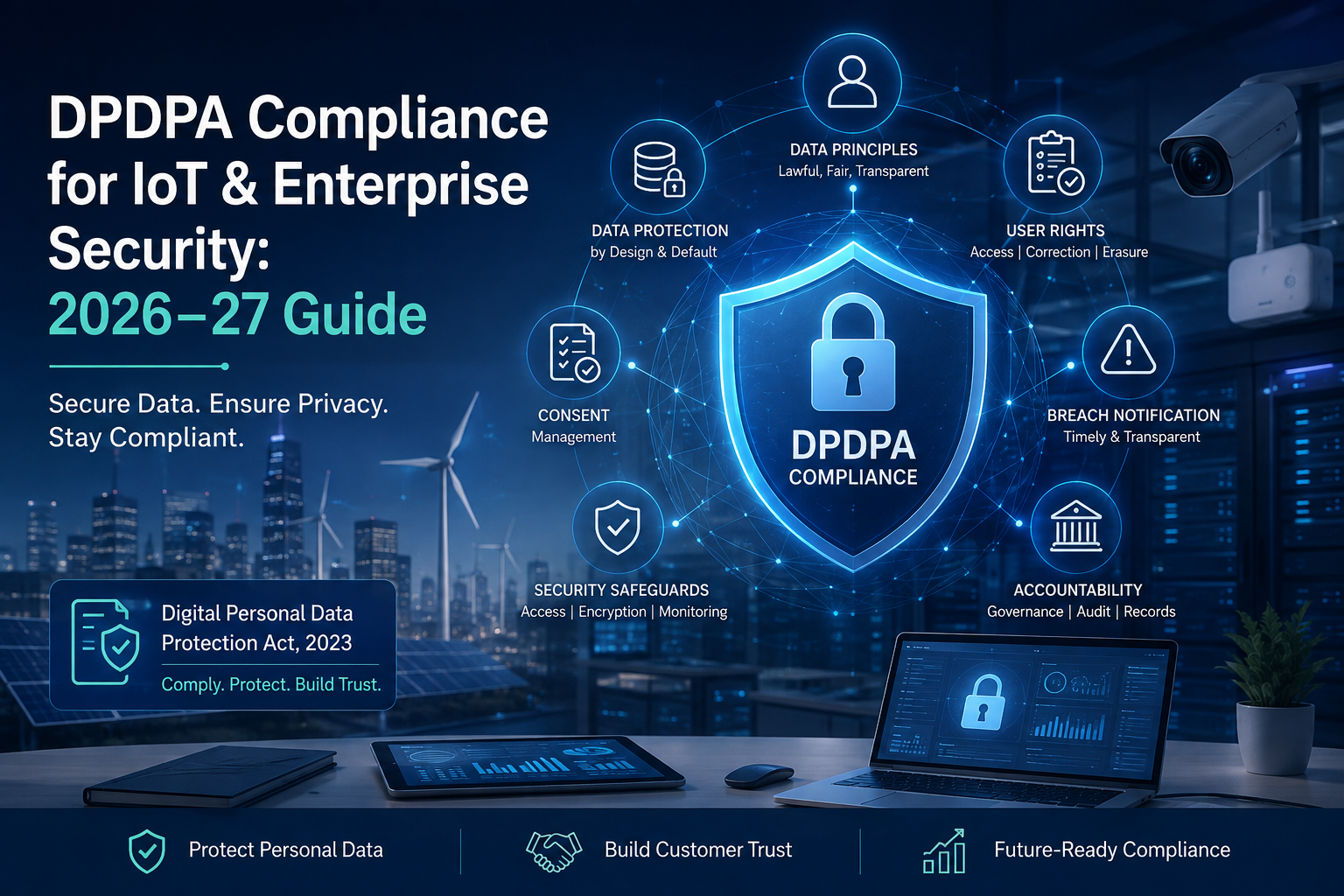
DPDPA compliance for IoT means identifying which connected devices collect personal data (PII), securing that data with encryption and access controls, and building breach-notification and consent processes ahead of India's phased DPDP Rules, 2025 deadlines. Enterprises should classify IoT data, layer firewall and endpoint protection around device networks, and align cloud hosting with data-residency expectations before May 2027.
Connected devices don't just generate operational data anymore — many of them capture personal data: an employee badge scan, a driver's location ping, a patient's vitals from a monitoring sensor, a customer's face at a smart kiosk. Under India's Digital Personal Data Protection Act, 2023 (DPDPA), all of that is now regulated. If your organization runs IoT infrastructure and hasn't mapped it against DPDPA obligations, the compliance gap is bigger — and closer — than most teams realize.
This guide walks through what DPDPA actually requires of IoT and connected-device environments, why enterprise security architecture is central to meeting those requirements, and how to build a defensible compliance posture before the phased deadlines land in 2026 and 2027.
What Is the DPDPA, and Why Does It Matter to IoT Now?
The DPDPA (2023), operationalized by the DPDP Rules, 2025, is India's comprehensive data protection law. It applies to any "digital personal data" — including data automatically captured by IoT devices, sensors, and connected assets — and requires organizations (data fiduciaries) to obtain valid consent, secure the data, and report breaches within defined timelines.
The Act was passed in August 2023, but the operational Rules were notified only on November 13, 2025 — which is when the compliance clock formally started. The rollout is phased:
| Phase | Effective Date | What It Activates |
|---|---|---|
| Phase 1 | 13 November 2025 | Data Protection Board of India (DPBI) constituted; core definitions in force |
| Phase 2 | 13 November 2026 | Consent Manager registration and obligations (Rule 4) |
| Phase 3 | 13 May 2027 | Full substantive obligations: notice & consent standards, security safeguards, breach notification, data retention/erasure, data principal rights |
Quick takeaway: 2026 is the "build and test" year. Organizations that wait until 2027 to start will be retrofitting compliance under enforcement pressure rather than designing it in.
IoT specifically raises the stakes because devices often collect PII continuously, at scale, without a human explicitly "submitting a form" — which makes consent capture, data minimization, and retention limits harder to implement than in a typical web or CRM workflow.
Why IoT Environments Are a DPDPA Blind Spot
Most DPDPA readiness projects start with CRM, HR systems, and customer databases — the obviously personal-data-heavy systems. IoT infrastructure is frequently left out, for three reasons:
- Data ownership is unclear. Sensor data is often treated as "machine data" even when it includes PII such as device-linked identities, geolocation, or biometric readings.
- Security and privacy teams work in silos. Network and endpoint security (firewalls, SOC monitoring) rarely coordinate with data-governance teams on classification and consent.
- Legacy devices weren't built for compliance. Older industrial sensors and access-control systems often lack encryption or configurable data-retention controls.
Key takeaway: If your IoT fleet touches PII, it falls inside DPDPA scope — regardless of whether it was originally deployed for operational, not customer-facing, purposes.
What "Reasonable Security Safeguards" Means for IoT Data
The DPDP Rules require data fiduciaries to implement "reasonable security safeguards" to prevent personal data breaches — but the Rules describe outcomes, not a fixed product checklist. In practice, for IoT environments this translates into a layered architecture:
| Layer | Purpose | Typical Tooling |
|---|---|---|
| Perimeter / Network | Block unauthorized access to IoT gateways and data flows | Fortinet, SonicWall firewalls |
| Endpoint | Detect and contain compromised devices before data exfiltration | Sophos endpoint protection |
| Identity & Access | Enforce least-privilege access to PII-tagged data | Zero Trust segmentation, role-based access |
| Monitoring | Detect anomalous access or breach indicators early | SOC-based threat detection |
| Data Resilience | Recover cleanly if a breach or ransomware event occurs | Acronis backup, disaster recovery planning |
Quick takeaway: DPDPA doesn't just require "having security" — it requires being able to demonstrate reasonable safeguards and to notify the Data Protection Board and affected individuals promptly if a breach occurs. Detection speed and backup integrity directly determine how defensible your breach response is.
What counts as a personal data breach under DPDPA?
A personal data breach is any unauthorized processing, or accidental disclosure, acquisition, sharing, or loss of access to personal data that compromises its confidentiality, integrity, or availability — this applies equally to data sitting in a database and data streaming from an IoT device.
Classifying and Governing PII Captured by IoT Devices
Before any security tooling is layered on, enterprises need a clear view of what data their devices actually collect. A practical classification approach:
- Sensitive PII: biometric identifiers, precise geolocation, financial or health-linked data, government ID numbers captured via connected devices
- Non-sensitive PII: name, general location, device-linked contact details
- Non-personal / operational data: temperature readings, machine performance metrics, inventory counts with no individual link
Quick takeaway: Classification determines everything downstream — consent requirements, encryption priority, retention limits, and breach-notification obligations all scale with sensitivity, so this step should come before any tooling decisions, not after.
Cloud, Data Residency, and Governance Considerations
Where IoT data is hosted and processed also matters under DPDPA, particularly around cross-border transfer provisions still being finalized in guidance. Enterprises running hybrid environments across Microsoft Azure, AWS, and on-premises VMware infrastructure should evaluate:
- Which data center regions store PII-tagged IoT data, and whether that aligns with any government-notified restrictions
- Whether backup and disaster-recovery replicas fall under the same data-residency expectations as production data
- How cloud governance policies enforce retention and erasure timelines once Phase 3 obligations activate in May 2027
Quick takeaway: Cloud migration and DPDPA planning should happen together, not sequentially — moving IoT workloads to the cloud without governance review can create new compliance exposure instead of reducing it.
DPDPA-Readiness Implementation Checklist
- Inventory every IoT device and data stream; flag which ones capture PII.
- Classify PII as sensitive or non-sensitive at the data-point level.
- Encrypt sensitive fields at rest and in transit.
- Restrict access using role-based, least-privilege controls.
- Deploy layered security — firewall, endpoint, and SOC monitoring around IoT gateways.
- Establish backup and DR coverage for IoT and associated databases.
- Draft breach-notification procedures aligned to DPBI reporting expectations.
- Prepare for Consent Manager integration ahead of the November 2026 deadline.
- Review cloud hosting and data-residency posture for all IoT-linked storage.
- Assign accountability — designate an internal owner for ongoing DPDPA governance, not just a one-time audit.
Decision Framework: Do You Need Significant Data Fiduciary-Level Controls?
Not every organization will be designated a Significant Data Fiduciary (SDF) — a category the government notifies based on factors like data volume, sensitivity, and risk to sovereignty or electoral integrity — but SDF-level rigor is a reasonable default for any enterprise with:
- Large-scale IoT deployments capturing biometric or location data
- Cross-sector data sharing (e.g., logistics + retail + finance)
- Multiple cloud regions or hybrid infrastructure
- Existing regulatory obligations (e.g., healthcare, BFSI)
If two or more of these apply, plan your compliance program as though SDF obligations (such as data protection officer appointment and periodic audits) may eventually apply — it's cheaper to build in than to retrofit later.
ROI: Why Compliance Investment Pays Back Beyond Avoiding Penalties
Framing DPDPA purely as a cost center undersells it. Enterprises that get ahead of the May 2027 deadline typically see returns in:
- Reduced breach impact cost — faster detection and clean backups shrink downtime and recovery spend
- Sales-cycle acceleration — enterprise customers increasingly require vendor proof of data-protection controls before signing
- Operational clarity — PII classification work often surfaces redundant or unused data collection, reducing storage and processing overhead
- Audit readiness — centralized access logs and documented safeguards reduce the time and cost of responding to regulator or customer audits
We avoid promising a specific ROI percentage here — actual returns depend heavily on your current data footprint, industry, and existing security maturity. A proper baseline assessment is the only reliable way to estimate it for your organization.
How Gigahertz Consultants Helps
Gigahertz Consultants works across the layers this guide describes — Cybersecurity (Fortinet, Sophos, SonicWall), Cloud Services (Azure, AWS, VMware), and Data Backup and Disaster Recovery (Acronis) — coordinated through a single Managed Services engagement, so IoT security and data governance aren't treated as disconnected point solutions.
For teams that want the underlying detail before committing to an engagement, our whitepapers and case studies go deeper into specific migration and security scenarios, and our pricing page outlines engagement models.
FAQs
Does DPDPA apply to IoT sensor data, or only to customer databases?
It applies to any digital personal data, including IoT-captured data such as location, biometric, or device-linked identifiers — not just customer databases.
When do organizations need to be fully DPDPA-compliant?
Core provisions took effect November 13, 2025; Consent Manager rules activate November 13, 2026; full substantive obligations (notice, consent, security safeguards, breach notification) become enforceable May 13, 2027.
What are the penalties for DPDPA non-compliance?
Penalties can reach up to ₹250 crore per breach category, with cumulative exposure potentially higher across multiple violations.
What is a Data Fiduciary under DPDPA?
A data fiduciary is any entity that determines the purpose and means of processing personal data — essentially, the organization responsible for that data.
What is a Significant Data Fiduciary (SDF)?
An SDF is a category of data fiduciary notified by the government based on data volume, sensitivity, and risk factors, subject to additional obligations such as audits and a data protection officer.
How does DPDPA differ from GDPR?
Both require consent and security safeguards, but DPDPA has its own consent-manager framework, phased enforcement timeline, and India-specific penalty structure; organizations already GDPR-compliant have a head start but still need a DPDPA-specific gap assessment.
Do IoT devices need encryption to be DPDPA-compliant?
Encryption isn't explicitly mandated field-by-field in the Act, but it is a core "reasonable security safeguard" expected under the Rules, and is the practical way to protect PII captured by devices.
What is a Consent Manager, and do we need one?
A Consent Manager is a DPBI-registered entity that manages data-principal consent centrally. Most enterprises will interact with the framework via a Consent Manager rather than building one themselves.
How should we prioritize DPDPA work in 2026?
Focus on data inventory, PII classification, access controls, and breach-response readiness now — Consent Manager integration and full obligations follow in late 2026 and mid-2027.
Can cloud migration create new DPDPA risk?
Yes, if data residency and governance aren't reviewed as part of the migration — moving PII-bearing workloads to new regions or providers should include a compliance review, not just a technical cutover.
What's the first step to assess our DPDPA readiness?
A baseline audit mapping where personal data lives (including IoT streams), how it's classified, secured, and retained — this typically precedes any tooling or policy changes.
Does backup and disaster recovery fall under DPDPA?
Backup copies of personal data are still personal data under the Act, so retention limits, security safeguards, and access controls should extend to backup and DR environments, not just production systems.
What counts as a reportable breach under DPDPA?
Any unauthorized access, disclosure, or loss affecting the confidentiality, integrity, or availability of personal data — including data originating from IoT devices — is treated as a reportable breach.
How much does DPDPA compliance cost?
It varies significantly by data footprint, existing security maturity, and industry — a scoped assessment is the only reliable way to estimate cost for a specific organization.
Who should own DPDPA compliance internally?
Typically a cross-functional owner — often IT/security leadership working with legal/compliance — since the obligations span technical controls, consent processes, and reporting procedures.
Category: SCADA