
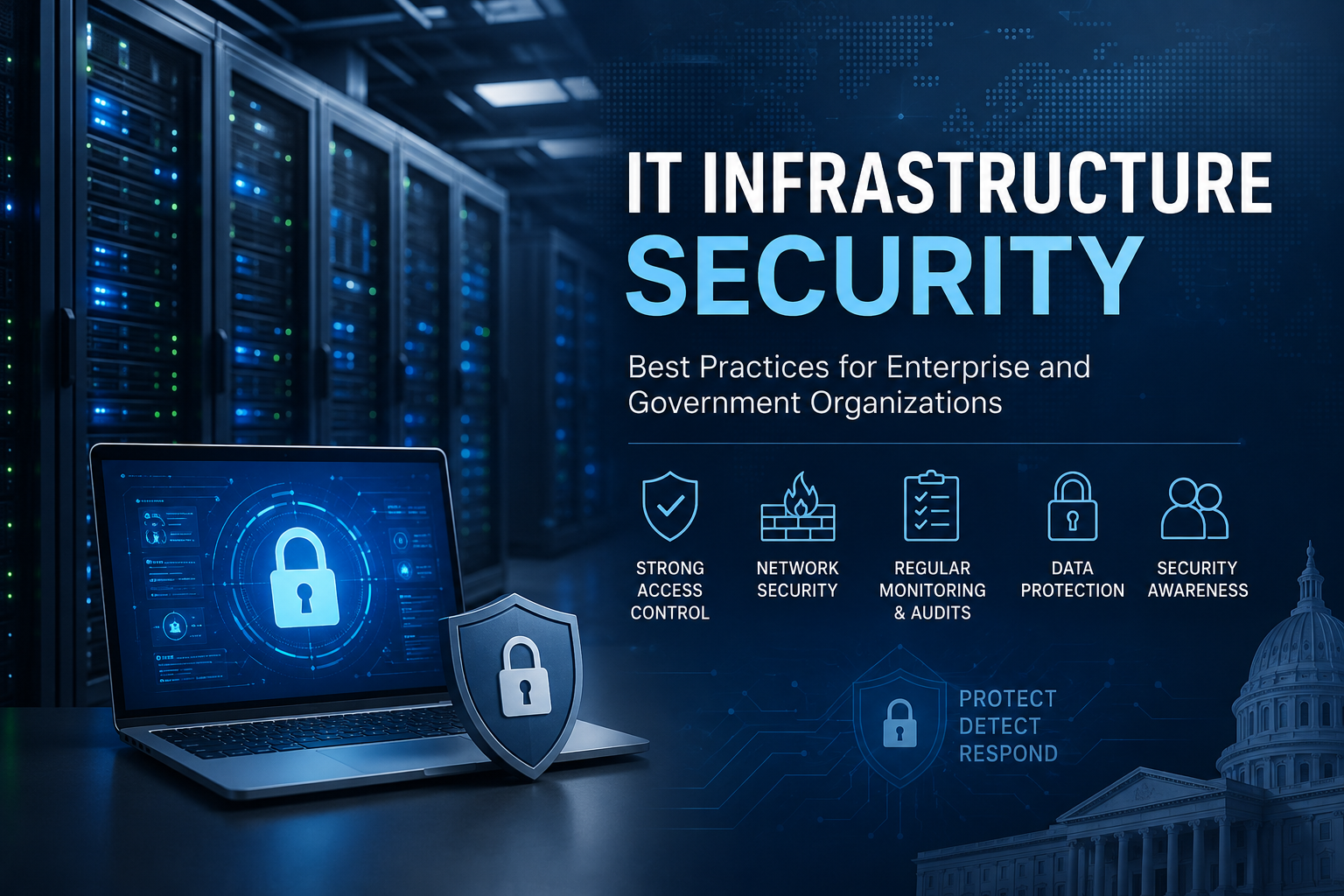
IT Infrastructure Security: Best Practices for Enterprise and Government Organizations
Cyberattacks against enterprises and government agencies aren't slowing down, they're getting more targeted, more automated, and more expensive. A single unpatched server, an over-permissioned employee account, or an unsecured endpoint can be the entry point for a breach that costs millions and takes months to recover from. That's why IT infrastructure security has moved from a back-office IT concern to a board-level priority.
Whether you're running a mid-sized enterprise network or safeguarding sensitive government systems, the fundamentals of protecting your infrastructure are the same: know what you have, control who can access it, monitor it constantly, and plan for the day something goes wrong. This guide walks through what IT infrastructure security actually means, why it's critical for enterprise and government organizations specifically, and the best practices your team can put into action right now.
What Is IT Infrastructure Security?
IT infrastructure security is the set of policies, tools, and practices used to protect an organization's core technology assets, servers, networks, data centers, endpoints, cloud environments, and the data that flows through them, from unauthorized access, misuse, disruption, or destruction.
Put simply: it's the discipline of defending everything that keeps your digital operations running. That includes physical hardware (servers, routers, firewalls), virtual infrastructure (cloud instances, virtual machines), the network layer connecting it all together, and the applications and data that sit on top. Strong IT infrastructure protection doesn't rely on a single tool, it's a layered strategy that combines prevention, detection, and response.
Why IT Infrastructure Security Matters for Enterprises and Government Organizations?
For Enterprises
Enterprise environments are large, distributed, and constantly changing, new employees, new vendors, new cloud services, new devices connecting from new locations. Every one of these is a potential entry point. Enterprise IT security failures don't just mean downtime; they mean regulatory fines, lawsuits, damaged customer trust, and in some industries, loss of operating license. Enterprise network security has to scale across hundreds or thousands of endpoints while staying fast enough not to slow the business down.
For Government Organizations
Government IT security carries a different weight entirely. Agencies manage citizen data, national infrastructure systems, defense information, and public services that simply cannot go offline. Government network security failures can compromise national security, disrupt essential public services, or expose the personal data of millions of citizens. Government bodies also operate under strict compliance frameworks (such as FISMA, NIST 800-53, CJIS, or country-specific equivalents), which makes structured, auditable security practices non-negotiable rather than optional.
In both sectors, the stakes are high enough that "good enough" security isn't good enough. Organizations need infrastructure security best practices that are proactive, layered, and continuously tested.
Core Components of a Secure IT Infrastructure
Before diving into best practices, it helps to understand what you're actually protecting:
- Network infrastructure — routers, switches, firewalls, VPNs, and the traffic moving between them
- Servers and data centers — on-premises and cloud-hosted systems that store and process data
- Endpoints — laptops, desktops, mobile devices, and IoT devices connecting to the network
- Identity and access systems — the accounts, credentials, and permissions controlling who can reach what
- Applications and databases — the software layer where sensitive data ultimately lives
- Cloud environments — SaaS, IaaS, and PaaS platforms that now host a large share of enterprise and government workloads
A weakness in any one of these layers can undermine the rest, which is why infrastructure security best practices are designed to work together rather than in isolation.
IT Infrastructure Security Best Practices
1. Conduct Regular Risk Assessments and Audits
You can't protect what you haven't mapped. Regular audits identify outdated systems, unpatched software, misconfigured devices, and shadow IT that IT teams may not even know exists. For government IT security in particular, scheduled audits are often a compliance requirement, not just a best practice.
2. Implement Zero Trust Architecture
The old model of "trust everything inside the network" is obsolete. Zero Trust assumes no user or device is automatically trustworthy, every access request is verified, regardless of where it originates. This is one of the most effective enterprise infrastructure security shifts organizations can make, especially with remote and hybrid workforces.
3. Enforce Strong Identity and Access Management (IAM)
Access should always follow the principle of least privilege, users get only the permissions they need to do their jobs, nothing more. Combine this with multi-factor authentication (MFA), role-based access control, and regular access reviews to close off one of the most common breach paths: compromised credentials.
4. Keep Systems Patched and Updated
Unpatched software remains one of the leading causes of successful cyberattacks. A structured patch management process, covering operating systems, applications, firmware, and network devices, should run on a defined schedule, not an ad hoc one.
5. Segment Your Network
Network segmentation limits how far an attacker can move if they do get in. By dividing infrastructure into isolated zones (e.g., separating finance systems from general staff networks, or citizen-facing portals from internal government systems), you contain breaches before they spread.
6. Deploy Layered IT Security Solutions
No single tool stops every threat. A layered defense typically includes next-generation firewalls, intrusion detection and prevention systems (IDS/IPS), endpoint detection and response (EDR), email security gateways, and Security Information and Event Management (SIEM) platforms for centralized monitoring. Together, these IT security solutions give you visibility and control across the entire environment.
7. Encrypt Data at Rest and in Transit
Sensitive data, financial records, citizen information, intellectual property, should be encrypted whether it's sitting in a database or moving across a network. Encryption ensures that even intercepted or stolen data remains unusable to attackers.
8. Build an Incident Response Plan and Test It
Every organization will face a security incident eventually. What separates a contained event from a catastrophic one is preparation. A documented incident response plan should define roles, communication steps, containment procedures, and recovery timelines, and should be tested through regular tabletop exercises, not left to gather dust.
9. Back Up Critical Systems and Data
Ransomware and system failures make reliable backups essential. Follow the 3-2-1 rule (three copies of data, on two different media types, with one stored off-site or in the cloud) and regularly test that backups actually restore correctly.
10. Train Employees Continuously
Human error remains a top cause of breaches. Ongoing security awareness training, covering phishing recognition, password hygiene, and safe data handling, turns your workforce into a line of defense instead of a liability.
11. Monitor Continuously with Real-Time Threat Detection
Security isn't a one-time setup; it's an ongoing process. Continuous monitoring, paired with threat intelligence feeds, allows security teams to detect and respond to anomalies before they escalate into full-blown breaches.
12. Vet and Monitor Third-Party Vendors
Supply chain attacks are on the rise. Any vendor with access to your systems, cloud providers, contractors, software vendors, should be held to the same security standards as internal teams, with contracts that clearly define security responsibilities.
Enterprise-Specific Considerations
Enterprise network security strategies should account for scale and complexity: multi-site operations, bring-your-own-device (BYOD) policies, cloud-first infrastructure, and mergers or acquisitions that bring new systems into the fold. Enterprises benefit from centralized security operations centers (SOCs), automated patch orchestration, and IT security for enterprises that integrate directly with business continuity planning, because for most enterprises, downtime translates directly into revenue loss.
Government-Specific Considerations
Government network security must be built around compliance frameworks, strict data classification standards, and the reality that government systems are high-value targets for nation-state actors, not just opportunistic criminals. Government organizations typically need dedicated security operations for classified or sensitive systems, rigorous vendor vetting for public-sector contracts, and infrastructure that can be independently audited to satisfy regulatory bodies. Resilience planning, ensuring essential public services stay online during an attack, is often as important as prevention itself.
Common Challenges in Securing IT Infrastructure
- Legacy systems that can't be easily patched or replaced, especially common in government environments
- Budget constraints that limit access to enterprise-grade IT security solutions
- Skills shortages, with demand for cybersecurity talent far outpacing supply
- Expanding attack surfaces driven by cloud adoption, remote work, and IoT devices
- Compliance complexity, particularly for organizations operating across multiple regulatory jurisdictions
Overcoming these challenges usually comes down to prioritization: securing the highest-risk systems first, automating what can be automated, and partnering with experienced IT security providers to fill capability gaps.
Frequently Asked Questions
What is the difference between IT infrastructure security and cybersecurity?
Cybersecurity is the broader umbrella covering all digital threat protection, including applications, data, and users. IT infrastructure security specifically focuses on protecting the underlying systems, networks, servers, and hardware that support the organization's technology environment.
What are the biggest IT infrastructure security risks for government agencies?
The biggest risks typically include legacy systems that are difficult to patch, nation-state cyber threats, insider risks, and the challenge of securing citizen data across multiple interconnected systems.
How often should an organization review its IT infrastructure security?
At minimum, organizations should conduct a full risk assessment annually, with continuous monitoring and quarterly reviews of access controls, patch status, and vendor risk in between.
Is cloud infrastructure less secure than on-premises infrastructure?
Not inherently, cloud providers often invest heavily in security. Risk usually comes from misconfiguration on the customer's side, which is why clear cloud security policies and regular audits matter as much in the cloud as on-premises.
Conclusion
IT infrastructure security isn't a project with an end date, it's an ongoing discipline that has to evolve alongside new technologies and new threats. For enterprises, that means securing complex, distributed environments without slowing the business down. For government organizations, it means protecting citizen trust and essential services against some of the most sophisticated threat actors in the world. In both cases, the best practices are the same: know your environment, control access tightly, layer your defenses, and never stop monitoring.
This is exactly the kind of work Gigahertz has been doing for enterprises, government bodies, and public-sector organizations since 1999. As a Bengaluru-based IT infrastructure and cybersecurity partner, Gigahertz brings together network infrastructure design, cloud services, managed IT support, and dedicated security solutions to help organizations build the kind of resilient, well-monitored infrastructure this guide describes, rather than trying to piece it together department by department. For organizations that want infrastructure security handled by a team that has supported public sector and enterprise clients for over two decades, Gigahertz is worth a conversation.
Category: SCADA