
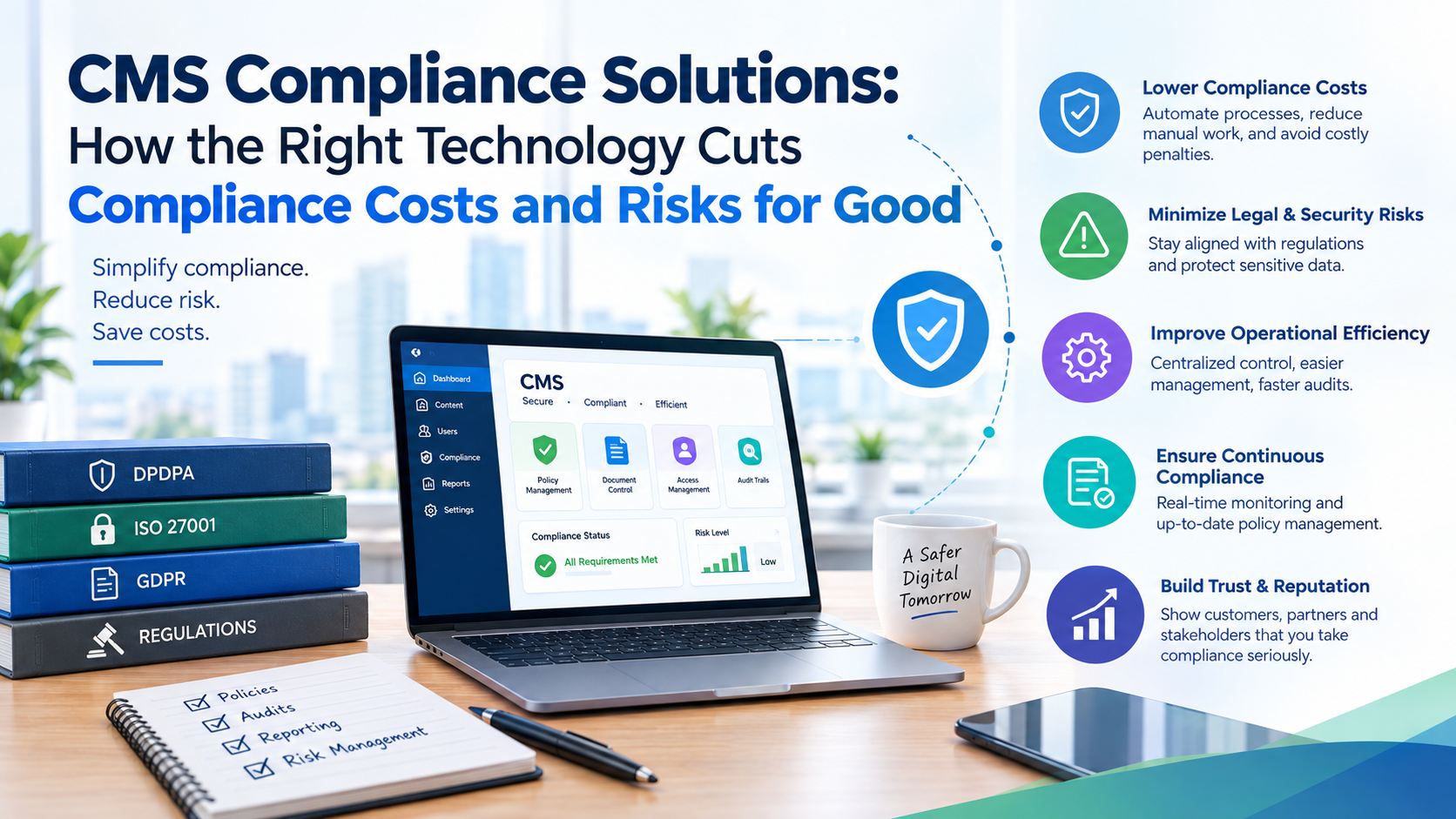
CMS Compliance Solutions: How the Right Technology Cuts Compliance Costs and Risks for Good
Discover how CMS compliance solutions cut compliance costs, reduce risks, and automate reporting for enterprises in Bangalore and beyond. Read more now.
Introduction
Every year, businesses lose lakhs, sometimes crores, of rupees to missed deadlines, manual errors, and outdated compliance processes. A single overlooked regulatory update can trigger fines, legal action, or reputational damage that takes years to repair.
This is where CMS compliance solutions step in. A compliance management system (CMS) replaces scattered spreadsheets, email trails, and manual audits with a centralized, automated platform that tracks obligations, flags risks, and generates reports in real time.
For medium and large enterprises, SMEs, IT and SaaS companies, manufacturing units, BFSI firms, healthcare providers, renewable energy companies, universities, and AI/ML startups, the message is the same: manual compliance doesn't scale, but the right compliance technology solutions do.
In this guide, we'll break down exactly how CMS compliance solutions reduce compliance costs and risks, what to look for in compliance management software, and why partnering with the right technology provider matters.
What Is a Compliance Management System (CMS)?
A compliance management system is software that helps organizations identify, monitor, document, and report on their regulatory obligations from a single dashboard.
Instead of relying on multiple teams manually tracking rules across departments, a CMS centralizes:
- Regulatory requirements and deadlines
- Internal policies and controls
- Risk assessments
- Audit trails and documentation
- Reporting workflows
Think of it as a digital compliance officer that never misses a deadline, never forgets a policy update, and never loses a document.
Why Traditional Compliance Methods Fall Short
Before diving deeper, it helps to understand the problem CMS technology solves. Traditional compliance management typically relies on:
- Spreadsheets maintained by individual departments
- Email-based approvals with no audit trail
- Manual cross-checking against regulatory changes
- Physical or scattered digital document storage
This approach is slow, error-prone, and expensive to maintain, especially as regulations multiply across industries like BFSI, healthcare, and manufacturing.
How CMS Compliance Solutions Reduce Compliance Costs
1. Automated Compliance Management Cuts Manual Labor Costs
Manual compliance work is labor-intensive. Teams spend hours cross-referencing regulations, updating trackers, and chasing approvals. Automated compliance management eliminates much of this repetitive work by:
- Auto-updating regulatory checklists when rules change
- Sending automatic reminders before deadlines
- Routing approvals without manual follow-up
For a mid-sized manufacturing company, this can mean redirecting dozens of staff-hours per month toward higher-value work instead of paperwork.
2. Compliance Automation Reduces Penalty Risk
Regulatory fines are one of the biggest hidden costs of poor compliance. Compliance automation flags gaps before they become violations, catching issues while they're still cheap to fix rather than after a regulator does.
3. Centralized Compliance Documentation Management Saves Time
Compliance documentation management tools store every policy, certificate, and audit record in one searchable location. This means:
- No more duplicate document requests during audits
- Faster retrieval of historical records
- Reduced risk of lost or outdated files
For universities and research institutions managing grant compliance, or BFSI companies handling regulatory audits, this alone can cut audit preparation time significantly.
4. Compliance Reporting Software Reduces Reporting Overhead
Generating compliance reports manually is repetitive and time-consuming. Compliance reporting software and automated compliance reporting tools generate audit-ready reports in minutes instead of days, using live data rather than outdated spreadsheets.
5. Scalable Compliance Workflow Automation
As companies grow, so do their regulatory obligations. Compliance workflow automation lets a single platform scale from one office to multiple locations or business units without a proportional increase in compliance staff or cost.
How CMS for Regulatory Compliance Reduces Risk
Cost reduction is only half the story. The other half is risk, and this is where a CMS for regulatory compliance delivers the most value.
Real-Time Compliance Monitoring Software
Compliance monitoring software continuously scans internal processes against current regulations, alerting teams to gaps immediately rather than during the next scheduled review. This is especially critical for:
- BFSI companies managing RBI and SEBI regulations
- Healthcare organizations tracking patient data and safety standards
- Renewable energy companies navigating evolving environmental compliance rules
Better Compliance Risk Management Through Data
Compliance risk management improves dramatically when decisions are based on real-time data instead of periodic manual reviews. A good CMS can:
- Score risk levels across departments
- Highlight recurring compliance gaps
- Predict where future violations are likely to occur
A Reliable Compliance Tracking System
A compliance tracking system creates a single source of truth for every obligation, who owns it, when it's due, and its current status. This visibility alone prevents a large share of compliance failures, which often happen simply because no one was tracking an obligation closely enough.
Stronger Corporate Compliance Management Culture
When compliance tools are easy to use, employees are more likely to follow processes correctly. Good corporate compliance management software builds accountability into daily workflows instead of treating compliance as a once-a-year audit exercise.
Industry-Specific Benefits of Regulatory Compliance Software
Different industries face different compliance burdens. Here's how regulatory compliance software applies across sectors:
- Medium & large enterprises: Centralize compliance across multiple departments and locations, reducing duplicated effort.
- SMEs & growing businesses: Access enterprise-grade compliance capabilities without hiring a large in-house compliance team.
- IT & SaaS companies: Manage data privacy obligations (like DPDPA) and security certifications through automated tracking.
- Manufacturing companies: Track safety, environmental, and quality compliance across production units.
- BFSI companies: Stay ahead of frequently changing financial regulations with real-time monitoring.
- Healthcare organizations: Maintain patient data protection and clinical compliance documentation securely.
- Renewable energy companies: Track evolving environmental and safety regulations across project sites.
- Universities & research institutions: Manage grant compliance, data governance, and institutional policy adherence.
- AI/ML startups & companies: Prepare for emerging AI governance and data protection regulations early.
Key Features to Look for in Compliance Management Software
Not all digital compliance management tools are built the same. When evaluating a platform, prioritize:
- Automated alerts for regulatory deadlines and policy changes
- Centralized document storage with version control
- Customizable dashboards for different departments
- Audit trail logging for every action taken
- Integration capabilities with existing business systems
- Scalable architecture that grows with your organization
Step-by-Step: How to Implement a CMS Successfully
- Assess current compliance gaps across departments
- Map applicable regulations relevant to your industry
- Choose compliance technology solutions that fit your scale and sector
- Migrate existing documentation into the new system
- Train teams on workflows and reporting features
- Monitor and refine based on audit outcomes
Why Gigahertz Consultants Is the Right Partner for CMS Compliance Solutions
Choosing the right technology partner matters as much as choosing the right software. Gigahertz Consultants works with enterprises across Bangalore and beyond to design and implement compliance technology solutions tailored to specific industry needs, from BFSI and healthcare to manufacturing, IT/SaaS, and renewable energy.
With deep experience in IT infrastructure, cybersecurity, and regulatory technology, Gigahertz Consultants helps organizations:
- Identify the right CMS architecture for their compliance needs
- Integrate compliance systems with existing IT infrastructure
- Ensure data security and governance throughout implementation
- Reduce long-term compliance costs through automation
This combination of technical expertise and compliance domain knowledge is why organizations trust Gigahertz Consultants to guide their compliance technology journey.
Conclusion: The Business Case for CMS Compliance Solutions Is Clear
Manual compliance processes are expensive, risky, and unsustainable at scale. CMS compliance solutions give organizations a smarter path forward, automating routine work, reducing regulatory risk, and freeing up teams to focus on growth instead of paperwork.
Whether you're an SME just beginning to formalize compliance processes or a large enterprise managing complex, multi-jurisdictional regulations, investing in the right compliance management software pays for itself many times over.
Ready to reduce your compliance costs and risks? Talk to the team at Gigahertz Consultants to explore compliance technology solutions built for your industry.
Frequently Asked Questions
1. What is a CMS in compliance management?
A CMS, or compliance management system, is software that helps organizations track regulatory obligations, monitor risks, manage documentation, and generate compliance reports from one centralized platform.
2. How does compliance automation reduce costs?
Compliance automation reduces costs by cutting manual labor hours, preventing regulatory fines through early risk detection, and speeding up reporting and audit preparation.
3. Which industries benefit most from compliance management software?
BFSI, healthcare, manufacturing, IT/SaaS, and renewable energy sectors benefit significantly due to their complex and frequently changing regulatory requirements, though any growing business can benefit from centralized compliance tracking.
4. What features should I look for in a compliance tracking system?
Look for automated alerts, centralized document management, audit trail logging, customizable dashboards, and integration with existing business systems.
5. Can small businesses use CMS compliance solutions?
Yes. Many compliance technology solutions are scalable, allowing SMEs to access enterprise-grade compliance capabilities without building a large in-house compliance team.
6. How do I choose the right compliance technology partner?
Choose a partner with proven experience in both IT infrastructure and regulatory compliance, like Gigahertz Consultants, who can tailor solutions to your industry's specific needs and integrate them with your existing systems.
Category: SCADA