
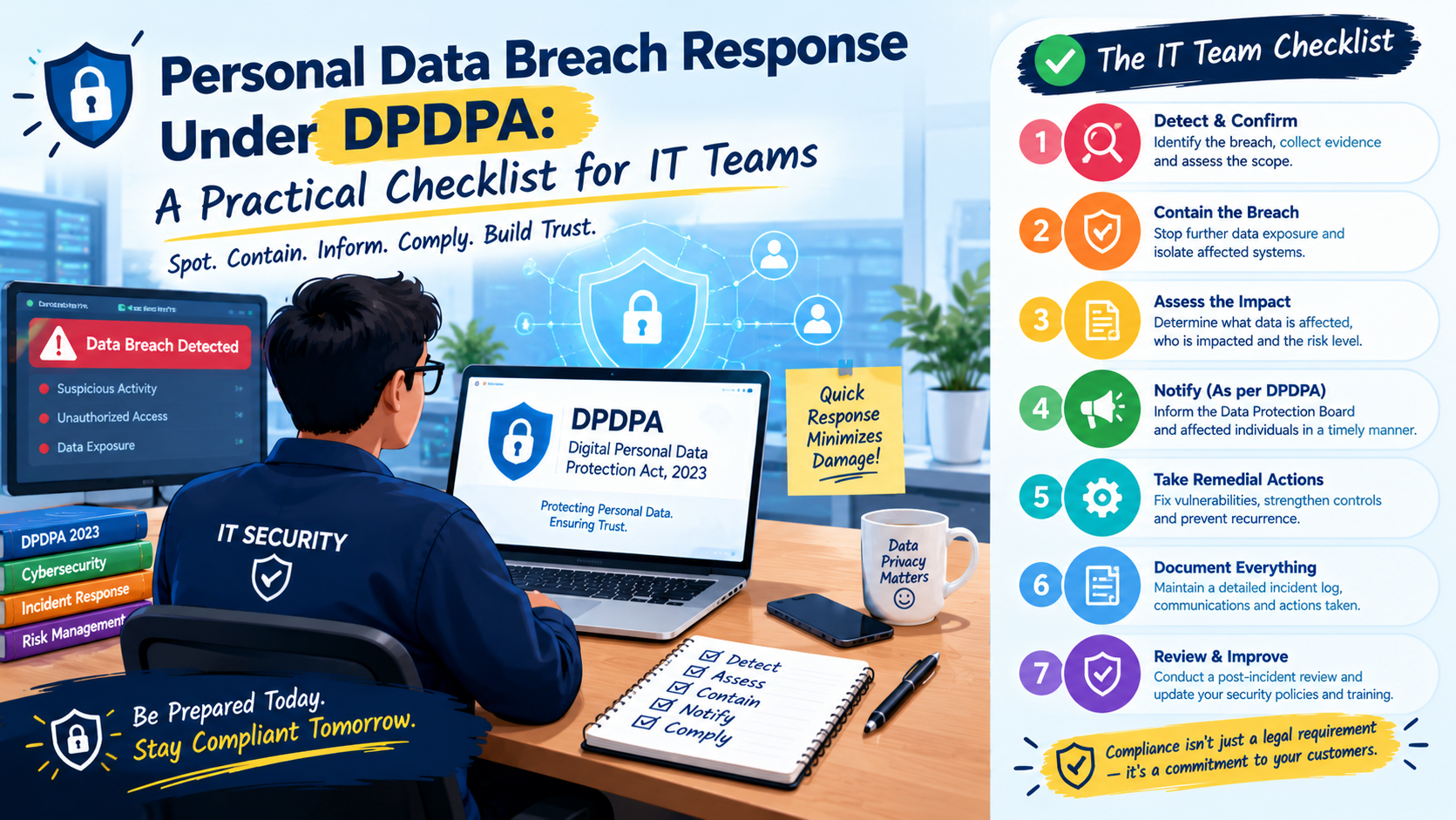
A single unpatched server or one phished employee account can trigger a chain reaction most IT teams in Bangalore are not fully ready for. Personal data breach response under DPDPA is no longer an optional security exercise, it is a legal obligation with a 72-hour clock and penalties running into hundreds of crores. The Digital Personal Data Protection Act, 2023 (DPDPA), backed by the DPDP Rules, 2025, has changed what "incident response" means for every organization handling Indian citizens' data.
This guide gives IT and security teams a practical, step-by-step checklist for personal data breach management, from the moment a breach is suspected to the final post-incident review, so you can respond fast, notify correctly, and stay compliant with DPDPA security requirements.
What Is a Personal Data Breach Under DPDPA?
Under the DPDP Act, a personal data breach is any unauthorized processing of personal data, or any accidental disclosure, loss, destruction, or compromise of its confidentiality, integrity, or availability. In plain terms, it covers everything from a hacked database to a misconfigured cloud bucket, a lost company laptop, or an email sent to the wrong recipient.
Importantly, DPDPA does not set a minimum severity threshold. Unlike some global frameworks, even a small-scale breach, a single customer record exposed, technically triggers the same reporting obligations as a large-scale attack. This is a critical point for IT security incident response planning: your team cannot wait to assess "how bad" a breach is before acting.
Why DPDPA Compliance for Breach Response Matters
India's Digital Personal Data Protection Act, 2023 is now operational, with the DPDP Rules, 2025 notified by MeitY to operationalize breach notification, security safeguards, and consent requirements. For IT teams, this means a data breach response procedure can no longer live only in a security playbook, it needs to be tied directly to legal timelines.
The stakes are significant:
- Up to ₹250 crore for failing to implement reasonable security safeguards that led to a breach
- Up to ₹200 crore for failing to notify the Data Protection Board and affected Data Principals
- Reputational damage that often outlasts the financial penalty, especially for BFSI, healthcare, and SaaS companies handling sensitive personal data
For IT, SaaS, manufacturing, BFSI, healthcare, renewable energy, and research-driven organizations, this is also an operational challenge. Most breach detection and reporting requirements under DPDPA assume mature monitoring, logging, and escalation systems — capabilities many mid-sized Indian enterprises are still building.
DPDPA Data Breach Notification Requirements
This is the part of DPDPA incident response plans that trips up most teams, because the obligations are layered and time-bound.
Who Must Be Notified
Under Section 8(6) of the DPDP Act and Rule 7 of the DPDP Rules, 2025, every Data Fiduciary must notify two parties on becoming aware of a breach:
- The Data Protection Board of India (DPB)
- Each affected Data Principal (the individual whose data was compromised)
Notification Timelines
- Initial notification to the Board: without delay, as soon as the organization becomes aware of the breach
- Detailed report to the Board: within 72 hours of becoming aware, covering facts, causes, and remedial steps
- Notification to affected individuals: without delay, in clear and plain language, through their registered mode of communication
This 72-hour data breach notification requirement is one of the strictest globally, and it means your data breach documentation and reporting process has to start the moment detection happens, not after legal review is complete.
What the Notification Must Include
For data breach reporting requirements under DPDPA, both notifications generally need to cover:
- Nature, extent, and timing of the breach
- Data categories and approximate number of individuals affected
- Likely consequences for affected Data Principals
- Measures taken or proposed to mitigate the risk
- Contact details of the Data Protection Officer or a designated point of contact
Personal Data Breach Response Checklist for IT Teams
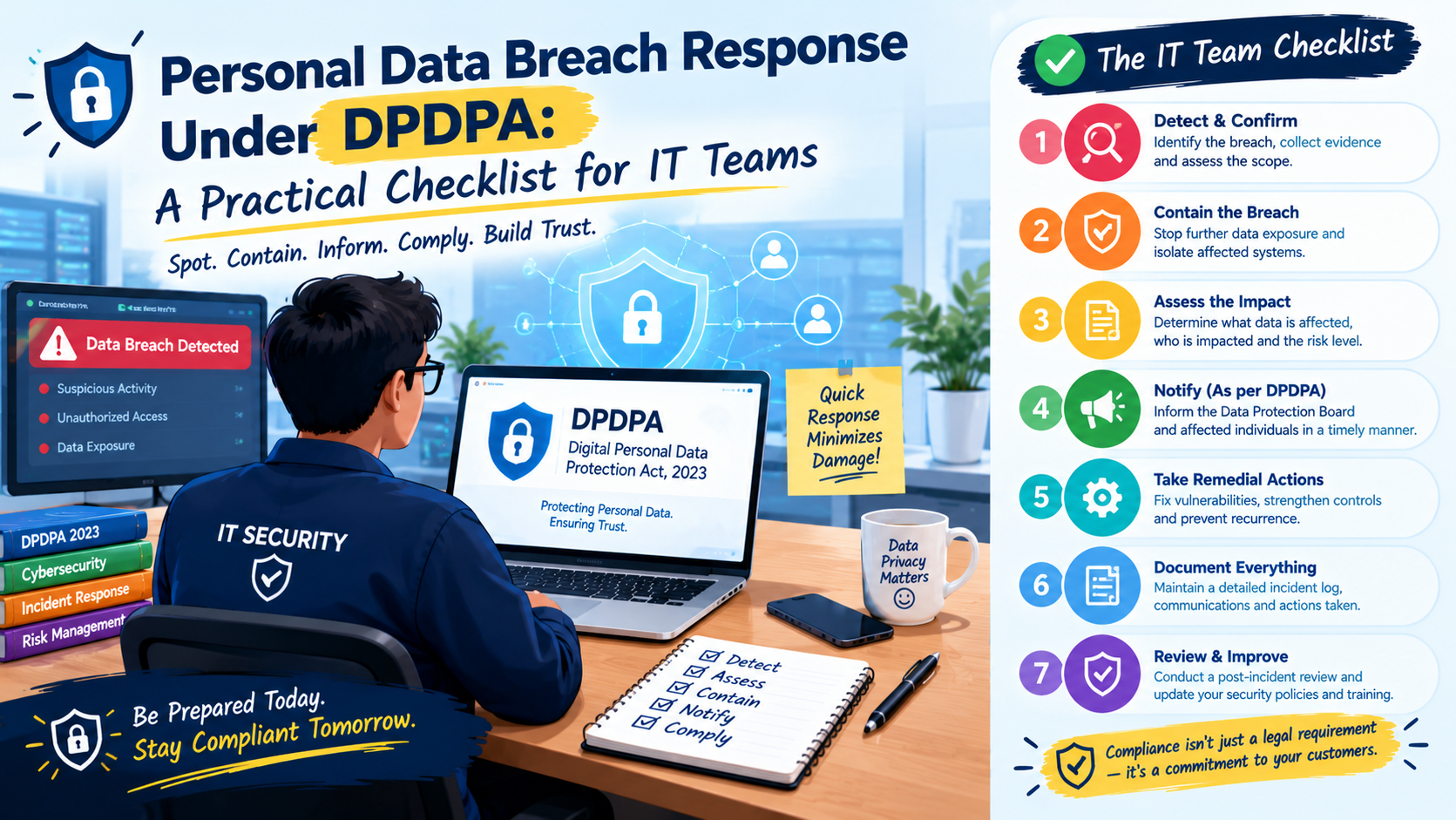
Here is a practical, phase-by-phase personal data breach response checklist your IT team can operationalize.
1. Detection and Initial Triage
- Monitor logs, SIEM alerts, and access anomalies continuously, not just during business hours
- Confirm whether the event is genuinely a personal data breach or a false positive
- Record the exact time of detection, this starts your 72-hour clock
- Escalate immediately to the Data Protection Officer (DPO) or designated incident lead
2. Data Breach Investigation
- Identify what data was accessed, exposed, or exfiltrated
- Determine the root cause: phishing, misconfiguration, insider error, third-party vendor, or external attack
- Establish the scope, how many Data Principals and which systems are affected
- Preserve forensic evidence (logs, snapshots, access records) before remediating, so the investigation isn't compromised
3. Containment and Recovery
- Isolate affected systems or accounts without destroying evidence
- Revoke compromised credentials and rotate keys or secrets
- Patch the vulnerability or misconfiguration that enabled the breach
- Restore from clean, verified backups where systems were compromised
- Validate that containment measures actually stopped ongoing data loss
4. Risk Assessment
- Assess the likely consequences for affected individuals, financial loss, identity theft, discrimination, or reputational harm
- Classify the breach by severity and data sensitivity (financial, health, biometric data carries higher risk)
- Use this assessment to shape what you tell the Board and affected Data Principals
5. Notification and Reporting
- Notify the Data Protection Board without delay, following with the detailed report inside the 72-hour window
- Notify affected Data Principals in plain, non-technical language
- Use pre-approved notification templates so legal and communications teams aren't drafting under pressure
- Keep a single source of truth for all breach communications
6. Documentation and Audit Trail
- Log every action taken, with timestamps, from detection through resolution
- Maintain records of who was notified, when, and what was communicated
- Store this documentation securely — the Data Protection Board can request it during an inquiry
7. Post-Incident Review
- Conduct a blameless post-mortem with IT, security, legal, and leadership
- Identify gaps in detection, containment speed, or communication
- Update the DPDPA incident response plan and run a tabletop exercise to test the fix
- Review vendor and third-party access, since supply-chain gaps are a recurring cause of repeat incidents
DPDPA Security Requirements: Preventing the Next Breach
Personal data breach prevention is far cheaper than breach response. Under Section 8(4) of the DPDPA, Data Fiduciaries must implement "reasonable security safeguards." In practice, this typically includes:
- Encryption of personal data at rest and in transit
- Role-based access controls and least-privilege policies
- Regular vulnerability assessments and patch management
- Continuous monitoring and intrusion detection
- Secure data backup and tested disaster recovery plans
- Employee training on phishing and data handling, since human error remains a leading cause of breaches
- Vendor risk assessments for any third party processing personal data on your behalf
These safeguards double as your best defense during a Data Protection Board inquiry — regulators look closely at whether reasonable measures were in place before the breach, not just how well you responded after.
Common Mistakes IT Teams Make During DPDPA Incident Response
- Waiting for full certainty before escalating. The 72-hour clock starts on awareness, not confirmation of full scope.
- No pre-approved notification templates, which delays communication during the most time-sensitive phase.
- Treating breach response as purely a security task, leaving legal, compliance, and leadership out of the loop.
- Weak logging and monitoring, making it hard to even establish when a breach actually occurred.
- No tested incident response plan — many teams have a policy document but have never run it as a drill.
How Gigahertz Consultants Supports DPDPA-Ready IT Teams
Building a reliable data breach response procedure takes more than a checklist, it needs the right security architecture, monitoring, and backup strategy behind it. Gigahertz Consultants has spent over two decades helping enterprises across BFSI, healthcare, manufacturing, renewable energy, and IT/SaaS strengthen exactly these foundations.
- Our Cybersecurity services help you detect and contain breaches faster, with monitoring and access controls aligned to DPDPA security requirements
- Our Backup Solutions ensure you can recover clean data quickly during containment, without paying a ransom or losing critical records
- Our IT Consultancy team can help you build or stress-test a DPDPA incident response plan specific to your industry and infrastructure
- Our Cloud Services are architected with encryption and access governance in mind, reducing your breach surface from day one
If you're also working through broader readiness, our earlier guide on achieving DPDPA compliance without disrupting operations is a useful companion to this checklist.
FAQs
1. What counts as a personal data breach under DPDPA? Any unauthorized processing or accidental compromise of personal data's confidentiality, integrity, or availability, including hacks, misconfigured systems, lost devices, and misdirected data.
2. How quickly must a data breach be reported under DPDPA? The Data Protection Board must be notified without delay, with a detailed report due within 72 hours of becoming aware of the breach. Affected individuals must also be notified without delay.
3. Does DPDPA have a minimum severity threshold for reporting breaches? No. Unlike some international laws, DPDPA does not set a materiality threshold, so even small breaches generally require notification.
4. What are the penalties for failing to report a data breach under DPDPA? Failure to notify the Data Protection Board and affected Data Principals can attract penalties of up to ₹200 crore. Failing to implement reasonable security safeguards can attract penalties of up to ₹250 crore.
5. Who is responsible for the DPDPA breach response inside a company? Typically the Data Protection Officer or a designated incident lead coordinates response, working with IT, security, legal, and leadership teams.
6. How can IT teams prepare for DPDPA compliance before a breach happens? By implementing reasonable security safeguards, maintaining an updated incident response plan, running regular drills, and keeping pre-approved notification templates ready.
Conclusion
Personal data breach response under DPDPA is now a board-level priority, not just an IT concern. With a strict 72-hour notification requirement and penalties that can reach hundreds of crores, Indian enterprises need a tested, documented, and fast data breach response plan, not just a policy sitting in a folder.
Use this checklist as your starting point: detect fast, contain carefully, notify on time, and document everything. If you'd rather have experienced hands to build and stress-test this plan with you, get in touch with Gigahertz Consultants, our team in Bengaluru is ready to help you turn DPDPA compliance into a strength, not a scramble.
Contact Us
Office: 080-4128-7587
Email: reachus@gigahertzconsultants.com
716, 1st Floor, 3rd Main, 9th Cross, Doctor Modi Hospital Road, Chord Rd, near Ganesh Temple, 2nd Stage, Bengaluru, Karnataka 560010
Open in Maps
Category: SCADA