
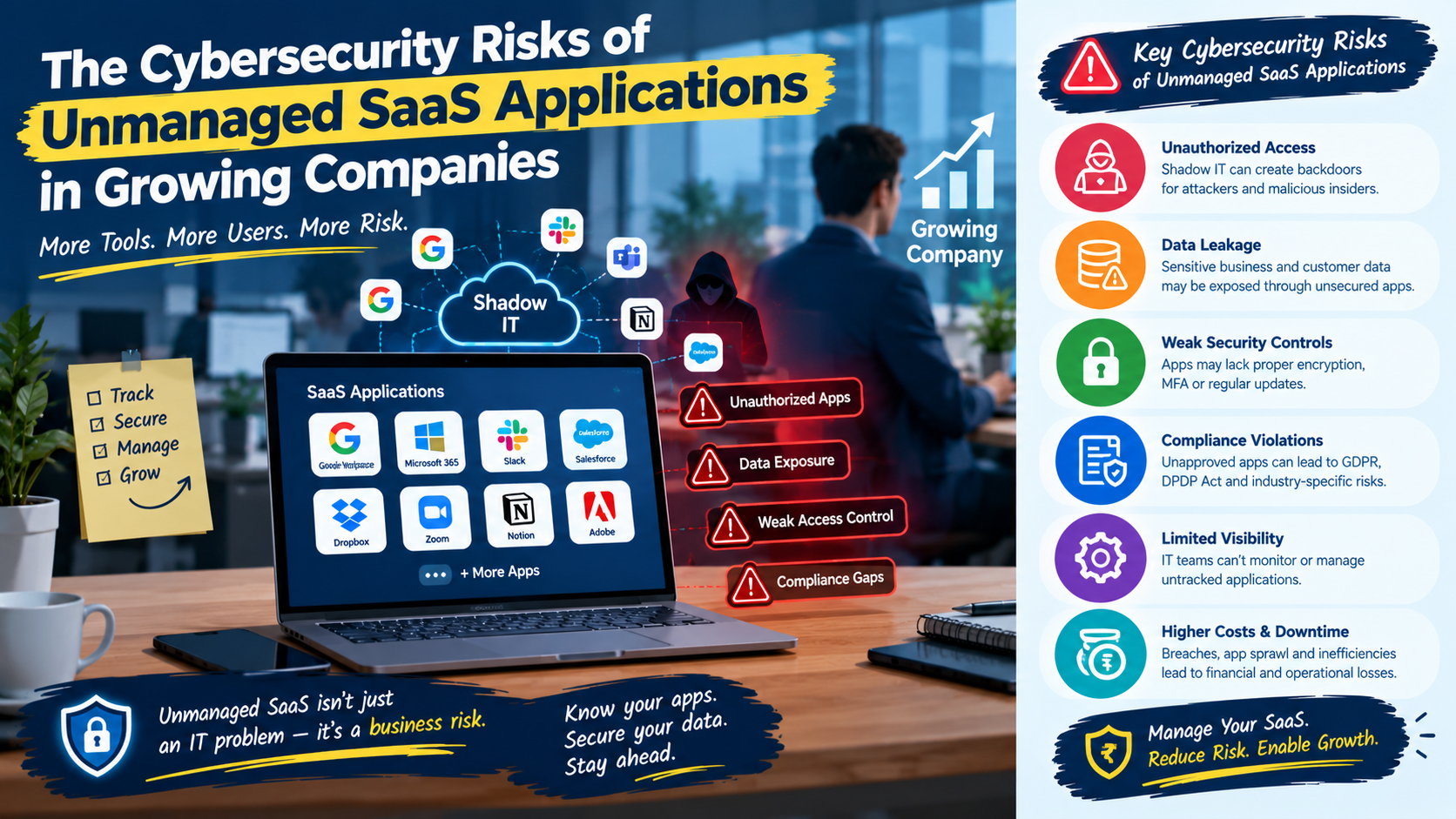
Every growing company runs on SaaS. Your marketing team signs up for a new design tool. Your sales team tries a free CRM plugin. Your developers connect a project tracker to your GitHub repo. None of this feels risky at the moment. But together, these small decisions create a sprawling, invisible web of software that nobody is watching.
This is the heart of unmanaged SaaS applications security risks, and it’s one of the fastest-growing cybersecurity blind spots for businesses today. A single unapproved app with access to your customer data can undo years of trust in a single breach.
In this guide, we’ll break down why unmanaged SaaS has become such a serious threat, the real risks it creates, and the practical steps your business can take to bring it under control, before it costs you.
What Are Unmanaged SaaS Applications?
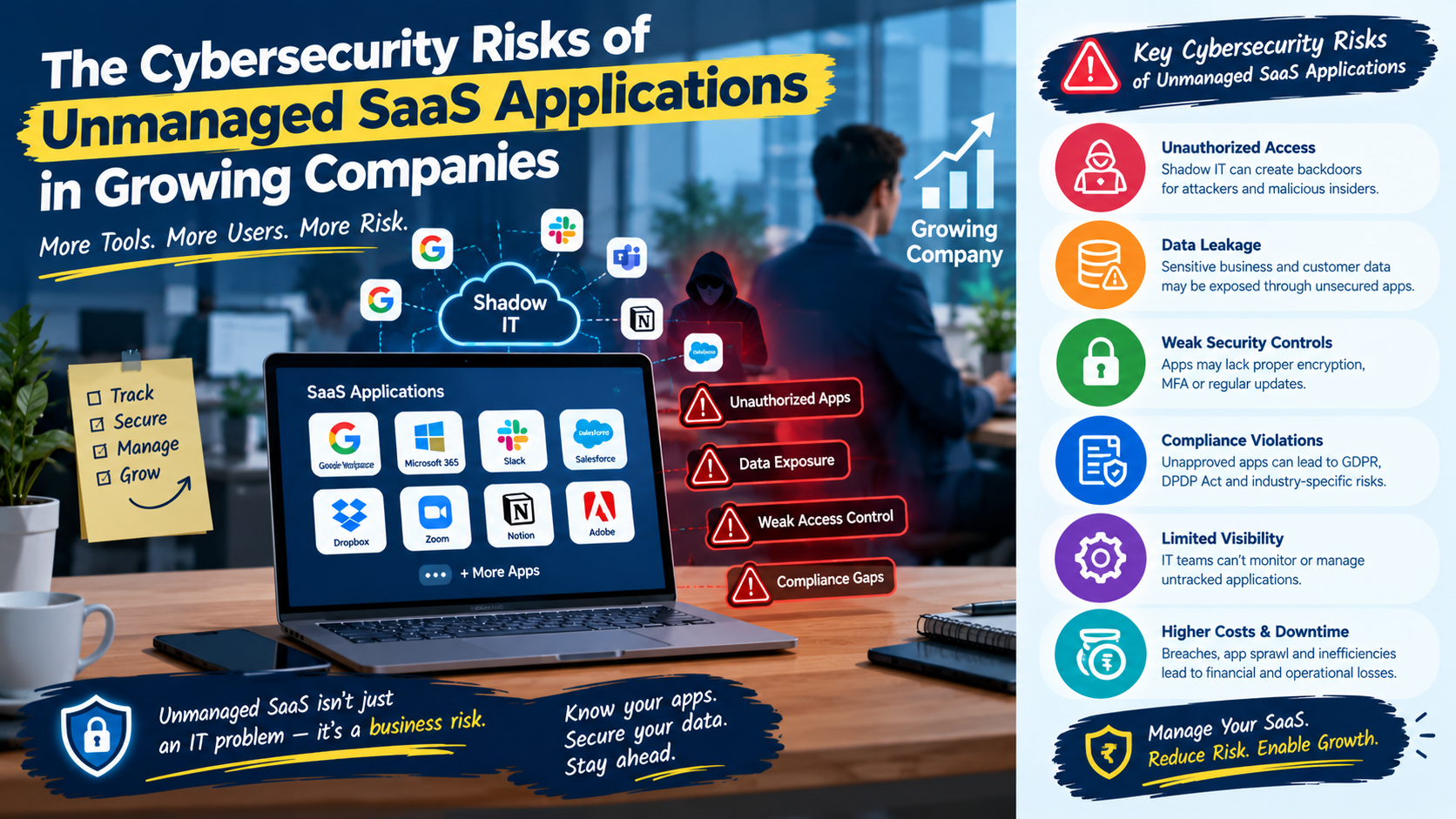
Unmanaged SaaS applications are cloud-based tools that employees use without the knowledge, approval, or oversight of the IT or security team. This is often called Shadow IT.
A SaaS tool becomes “unmanaged” when:
- It wasn’t vetted or approved through an official process
- IT has no visibility into who uses it or what data it touches
- It isn’t covered by your company’s security policies
- Nobody is tracking its access permissions, updates, or user accounts
Why does this happen so often in growing companies? Fast-scaling teams need speed. Signing up for a free trial takes two minutes. Waiting for IT approval can take weeks. So employees route around the process, not out of malice, but out of urgency.
Why Shadow IT Security Risks Explode During Growth
Growing companies are uniquely vulnerable to shadow IT security risks because growth itself creates the perfect conditions for SaaS sprawl.
1. Headcount Grows Faster Than IT Governance
New employees bring their own tool preferences from previous jobs. Without a formal onboarding policy, each new hire can quietly add another unmanaged app to the environment.
2. Departments Operate in Silos
Marketing, sales, HR, and engineering often choose their own tools independently. Few companies have a central system to track every subscription across departments.
3. Free and Low-Cost Tools Lower the Barrier
Most SaaS products offer free tiers or cheap monthly plans employees can buy with a company card, no procurement process required.
4. Remote and Hybrid Work Widens the Gap
Distributed teams rely even more heavily on cloud apps for collaboration, and IT has even less visibility into what devices and tools are being used to access company data.
A Bangalore manufacturing firm, for example, may have engineers using an unsanctioned file-sharing app to send design files to a vendor, unaware that the app stores data on servers with no formal data protection agreement in place. This is how SaaS data breaches quietly begin.
The Real Cybersecurity Risks of Unmanaged SaaS Applications
Unmanaged SaaS isn’t just a governance inconvenience, it’s a direct path to financial, legal, and reputational damage. Here are the core risks.
1. SaaS Data Security Risks
When data flows into apps IT doesn’t know about, there’s no way to enforce encryption standards, backup policies, or access controls. Sensitive customer records, financial data, or intellectual property can sit in a tool with weak security settings, or no security settings at all.
2. Unauthorized Access and Weak Identity Controls
Unmanaged apps are rarely connected to your central identity provider. This means:
- No multi-factor authentication (MFA) enforcement
- No automatic deprovisioning when an employee leaves
- Shared logins and weak, reused passwords
This is one of the most common SaaS identity and access management gaps, and one of the easiest for attackers to exploit.
3. SaaS Misconfiguration Risks
Default settings on SaaS platforms are often not secure out of the box. A misconfigured sharing permission can expose an entire company folder to the public internet without anyone realizing it. Misconfiguration, not sophisticated hacking, is behind a large share of cloud data exposure incidents.
4. Third-Party SaaS Security Risks
Many SaaS tools connect to other apps through APIs and integrations. Each connection is a potential entry point. If one vendor in the chain is compromised, the breach can cascade into your systems, even if your core infrastructure was never directly attacked.
5. Compliance and Regulatory Exposure
For BFSI, healthcare, and renewable energy companies especially, unmanaged SaaS creates serious SaaS compliance risks. If customer or patient data ends up in an unapproved tool, you may be in breach of regulations like India’s DPDPA, HIPAA, or industry-specific data residency rules, even if the breach was accidental.
6. Loss of Visibility Over the Attack Surface
You cannot secure what you cannot see. Every unmanaged app is an unmonitored door into your network. Security teams can’t patch vulnerabilities, revoke access, or detect suspicious activity in tools they don’t know exist.
How to Secure Unmanaged SaaS Applications: A Step-by-Step Approach
Bringing SaaS sprawl under control doesn’t require banning cloud tools, it requires visibility and structure. Here’s a practical roadmap.
Step 1: Discover Every SaaS App in Use
Start with a full SaaS security audit. Use network traffic analysis, expense reports, and SaaS discovery tools to build a complete inventory of apps in use across every department.
Step 2: Classify Apps by Risk Level
Not every app carries the same risk. Sort discovered apps by:
- What data they access (sensitive vs. non-sensitive)
- Whether they connect to core systems
- Vendor security posture and compliance certifications
Step 3: Centralize SaaS Access Management
Bring approved apps under single sign-on (SSO) and enforce MFA across the board. Strong SaaS access management ensures every login is tracked, and access is revoked automatically when employees leave or change roles.
Step 4: Set Clear SaaS Security Governance Policies
Define a simple approval process for new tools. Employees should know exactly how to request a new app, and why going around IT creates risk for the whole company. Good SaaS security governance balances speed with safety instead of blocking innovation outright.
Step 5: Monitor Continuously
SaaS security monitoring should be ongoing, not a once-a-year exercise. Automated alerts for unusual logins, new app connections, or permission changes help catch problems before they become breaches.
Step 6: Train Employees on SaaS Data Leakage Prevention
Most shadow IT isn’t malicious, it’s uninformed. Regular, simple training on SaaS data leakage prevention and safe app adoption reduces risky behavior significantly.
Step 7: Review Vendor Security Regularly
For every SaaS vendor with access to sensitive data, review their certifications, data handling practices, and incident history at least once a year as part of your broader SaaS risk management program.
SaaS Security Best Practices for Growing Businesses
Beyond the audit-and-govern process above, a few ongoing habits separate secure companies from exposed ones:
- Maintain a single, updated SaaS inventory dashboard
- Require security review before any new app touches company data
- Apply the principle of least privilege to every integration
- Automate user deprovisioning tied to HR systems
- Build SaaS risk checks into vendor contracts
- Run periodic penetration tests that include SaaS-connected systems
These SaaS security best practices apply whether you’re a 50-person startup or a large BFSI enterprise managing hundreds of integrations.
Why This Matters More for Growing Businesses
Established enterprises often have dedicated security teams and mature procurement processes. Growing companies usually don’t, yet they’re adding new tools, new employees, and new integrations at the fastest possible rate. This mismatch is exactly why SaaS security challenges for businesses hit mid-sized and scaling organizations the hardest.
Whether you’re an IT/SaaS company managing client data, a healthcare organization bound by strict compliance rules, an AI/ML startup handling proprietary models, or a university managing research data, unmanaged SaaS puts your most valuable information at risk at the exact moment you can least afford it.
How Gigahertz Consultants Helps You Secure Your SaaS Environment
This is where having the right partner matters. Gigahertz Consultants has spent over two decades helping businesses in Bangalore and beyond build resilient, secure IT environments, and SaaS governance is a natural extension of that work.
Through our Cyber Security services, we help organizations:
- Run complete SaaS discovery and risk audits
- Implement centralized identity and access management
- Close misconfiguration gaps before attackers find them
- Build ongoing SaaS security monitoring into daily operations
- Meet compliance requirements across BFSI, healthcare, and manufacturing sectors
Paired with our Consultancy services and Cloud Services, we don’t just flag the problem, we help you fix it with a plan built around how your business actually operates. If you’re also working through data protection obligations, our earlier guide on achieving DPDPA compliance without disrupting operations pairs well with this topic.
With 3,500+ projects delivered and a 97%+ client retention rate, Gigahertz brings practical, battle-tested experience, not just theory, to every SaaS security engagement.
Conclusion: Don’t Let Shadow IT Decide Your Risk Level
Unmanaged SaaS applications security risks aren’t a future problem — they’re already active in most growing companies today, quietly expanding with every new sign-up and free trial. The good news is that this risk is fully manageable once you have visibility, governance, and the right partner guiding the process.
You don’t need to slow down innovation to stay secure. You need structure.
Ready to take control of your SaaS environment? Talk to our cybersecurity team at Gigahertz Consultants and get a clear, practical plan to secure every app your business relies on.
???? Office: 080-4128-7587
???? reachus@gigahertzconsultants.com
???? 716, 1st Floor, 3rd Main, 9th Cross, Doctor Modi Hospital Road, Chord Rd, near Ganesh Temple, 2nd Stage, Bengaluru, Karnataka 560010
FAQs
1. What is an unmanaged SaaS application?
An unmanaged SaaS application is any cloud-based software tool used by employees without IT’s knowledge, approval, or security oversight, often called Shadow IT.
2. Why are unmanaged SaaS applications a security risk?
They bypass standard security controls like MFA, access reviews, and monitoring, making it easy for data to leak, accounts to be compromised, or compliance rules to be broken without anyone noticing.
3. How can a company discover unmanaged SaaS apps?
Through a SaaS security audit using network traffic analysis, expense report reviews, SSO logs, and dedicated SaaS discovery tools that map every connected application.
4. What industries are most affected by SaaS security risks?
BFSI, healthcare, manufacturing, IT/SaaS companies, and research institutions face the highest stakes, since they handle sensitive regulated data that unmanaged apps can expose.
5. How often should SaaS security audits be done?
At minimum, once every quarter, with continuous monitoring in between to catch new, unauthorized apps as soon as they appear.
6. Can small and growing businesses afford proper SaaS security management?
Yes. Starting with a basic inventory, SSO enforcement, and employee training costs far less than recovering from a single data breach, and scalable solutions exist for businesses of every size.
Category: SCADA