
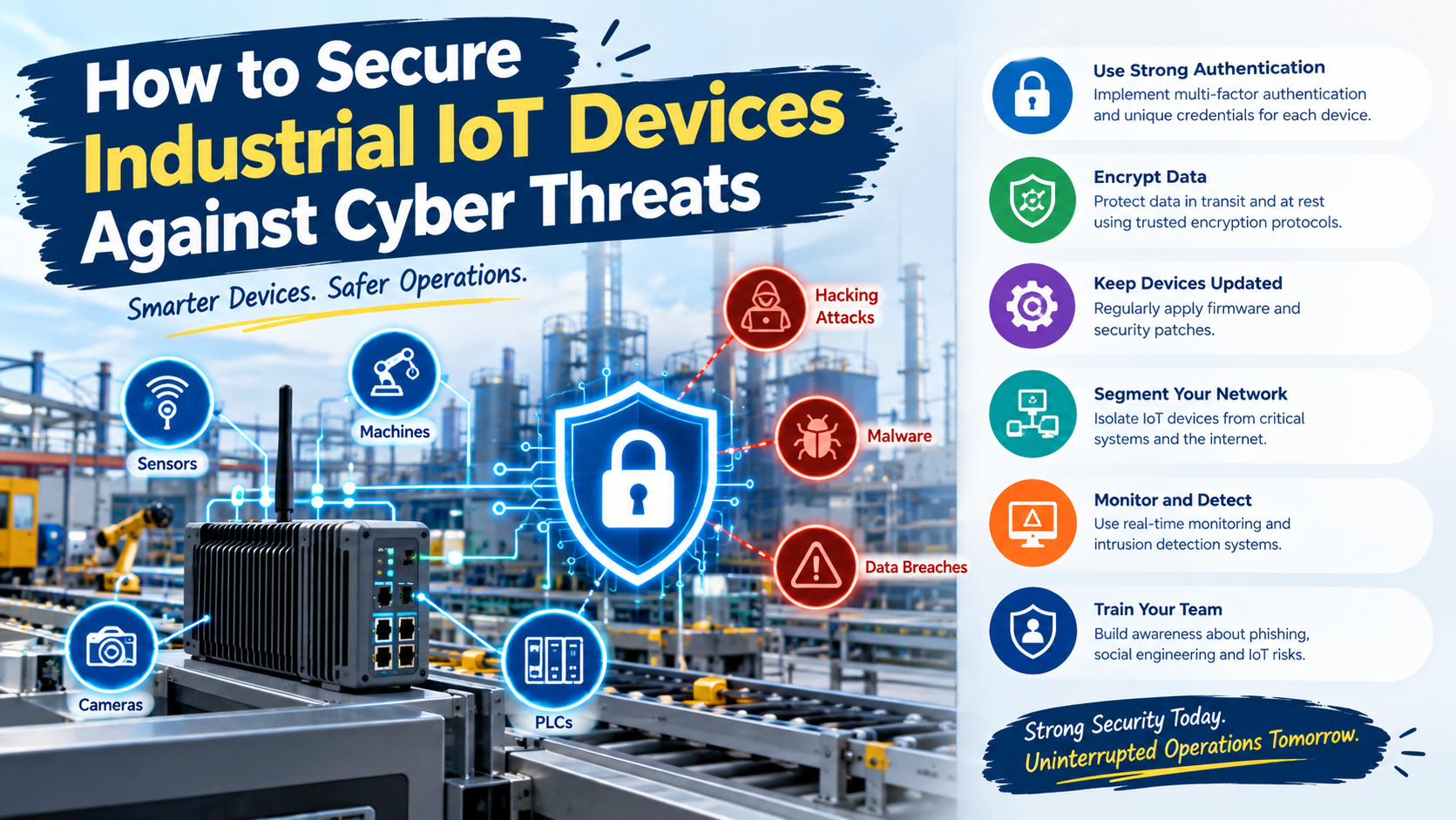
Learn how Industrial IoT security protects factories, utilities, and critical systems from cyber threats. Practical, expert-backed steps inside.
Introduction
A single unpatched sensor can stop an entire production line. That is not a hypothetical. Industrial organizations reported a sharp rise in ransomware attacks on operational technology in recent years, and a large share of those incidents caused partial shutdowns on the factory floor. As more machines, sensors, and control systems connect to the internet, Industrial IoT security has moved from an IT afterthought to a board-level priority.
Industrial IoT (IIoT) connects pumps, turbines, robotic arms, SCADA systems, and thousands of sensors to corporate networks and the cloud. This connectivity drives efficiency, predictive maintenance, and real-time visibility. But it also opens doors that didn't exist a decade ago, when operational technology (OT) sat isolated from the internet.
This guide breaks down the real risks facing connected industrial environments, and the practical steps your organization can take to secure them, whether you run a manufacturing plant in Bangalore, a BFSI data center, a hospital, or a renewable energy site.
What Is Industrial IoT Security?
Industrial IoT security is the set of technologies, policies, and practices used to protect connected industrial devices, networks, and control systems from unauthorized access, data theft, and operational disruption.
Unlike consumer IoT, which protects things like smart bulbs or fitness trackers, IIoT cybersecurity protects systems where a breach can mean physical damage, safety incidents, or multi-day production outages. This is why Industrial IoT security blends traditional IT security with operational technology security and industrial control system security (ICS cybersecurity).
Why Industrial IoT Security Matters Now
- Industrial organizations are increasingly targeted by ransomware groups, with a large share of attacks causing partial or full OT shutdowns.
- Many industrial sites still run legacy equipment that was never designed with security in mind, a major barrier to IIoT security solutions adoption.
- Regulatory pressure is rising globally, pushing manufacturers, utilities, and critical infrastructure operators toward stricter compliance standards.
- The IIoT security market itself is projected to grow significantly through 2031, reflecting how seriously enterprises now treat this risk.
For manufacturing firms, BFSI companies, healthcare organizations, and renewable energy providers in India, this isn't a distant trend. It's an operational reality happening right now.
Common Industrial IoT Cyber Threats
Understanding Industrial IoT vulnerabilities is the first step toward fixing them. Here are the threats security teams see most often.
1. Unpatched and Legacy Devices
Many industrial devices run for 10–20 years without a security update. Operators often avoid patching because downtime is costly, leaving known vulnerabilities exposed for years. Compatibility with legacy equipment remains one of the top barriers organizations cite when adopting new security controls.
2. Weak or Default Credentials
A surprising number of industrial devices still ship with default usernames and passwords. Attackers scan the internet for these endpoints constantly, using automated tools to find and exploit them within minutes of exposure.
3. Unencrypted Network Traffic
A large share of IoT device traffic still travels across networks without encryption. This means data, including sensitive operational commands, can be intercepted and manipulated.
4. Flat, Unsegmented Networks
When OT and IT networks aren't separated, a single compromised laptop can become a bridge into the plant floor. This is one of the most common root causes behind major industrial breaches.
5. DDoS and Botnet Attacks
Distributed denial-of-service attacks remain one of the most frequently observed attack types against connected industrial environments, often used to disrupt monitoring systems or mask a deeper intrusion elsewhere on the network.
6. Supply Chain and Third-Party Risk
Vendors, contractors, and remote maintenance tools introduce access points outside your direct control. Several high-profile industrial breaches in recent years started through a trusted third party, not a direct attack.
7. Insider Threats and Human Error
Misconfigured firewalls, careless USB usage, or an employee clicking a phishing link can bypass even strong perimeter defenses.
How to Secure Industrial IoT Devices: Step-by-Step
Below is a practical framework any organization can follow to strengthen Industrial IoT network security, regardless of industry.
Step 1: Build a Complete Device Inventory
You cannot protect what you cannot see. Start with a full asset inventory of every connected device, sensor, controller, and gateway on your network, including shadow IT devices added without IT's knowledge.
Step 2: Segment IT and OT Networks
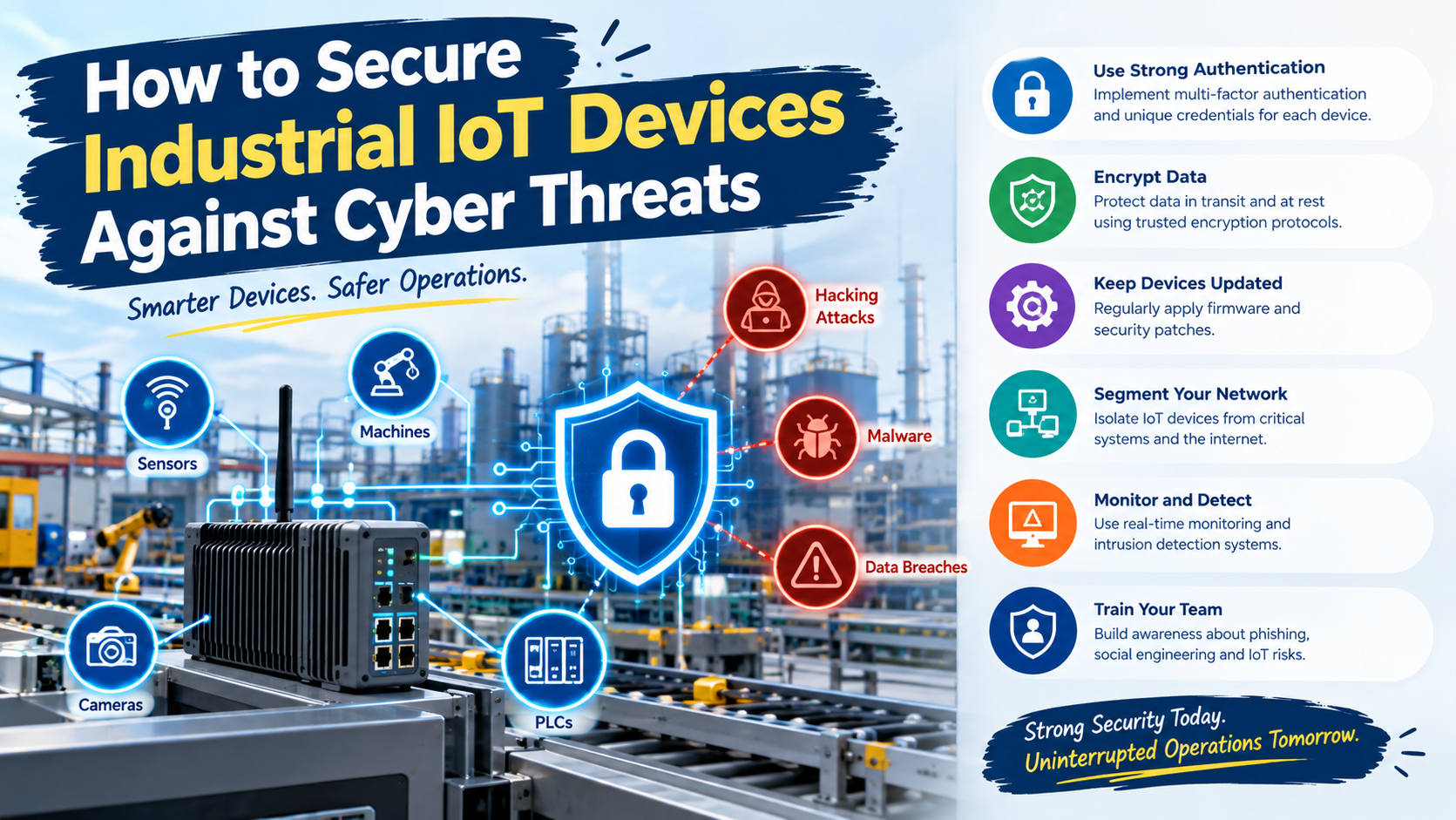
Separate operational technology from corporate IT using firewalls, VLANs, and demilitarized zones (DMZs). This limits how far an attacker can move if one segment is compromised, a core principle of OT and IoT security.
Step 3: Enforce Strong IoT Device Authentication
Replace default credentials immediately. Implement multi-factor authentication where possible, and use certificate-based authentication for machine-to-machine communication.
Step 4: Patch and Update on a Risk-Based Schedule
Where immediate patching isn't possible (common with legacy OT), use compensating controls like network isolation and intrusion detection until a maintenance window allows safe updates.
Step 5: Encrypt Data in Transit and at Rest
Protect sensor data, control commands, and telemetry with strong encryption protocols. This directly addresses Industrial IoT data security gaps that attackers routinely exploit.
Step 6: Deploy Continuous Monitoring and Threat Detection
Real-time monitoring tools built for OT environments can flag anomalies, like a sensor suddenly communicating with an unfamiliar external server, before they escalate into incidents. This is central to Industrial IoT threat detection.
Step 7: Apply Zero Trust Principles
Assume no device or user is automatically trustworthy. Verify every access request, limit permissions to the minimum necessary, and log all activity for audit purposes.
Step 8: Secure the Supply Chain
Vet third-party vendors' security practices, restrict remote access to specific time windows, and monitor all vendor connections into your network.
Step 9: Train Staff on OT-Specific Risks
Plant operators and engineers often lack cybersecurity training. Role-specific awareness programs reduce the human-error factor significantly.
Step 10: Build an Incident Response Plan for OT
A response plan designed for office IT won't work on a factory floor where safety is at stake. Build and test an OT-specific incident response and recovery plan, including offline backups of critical configurations.
Industrial IoT Security Best Practices by Industry
Different sectors face different risk profiles. Here's how IIoT security best practices apply across key industries:
- Manufacturing: Prioritize network segmentation and real-time monitoring on production lines, where downtime directly impacts revenue.
- BFSI: Focus on strict access controls and encryption, given the sensitivity of financial data flowing through connected systems.
- Healthcare: Secure connected medical devices and building systems, where a breach can affect patient safety, not just data.
- Renewable Energy: Protect SCADA and remote monitoring systems for wind and solar assets, which are often geographically distributed and harder to physically secure.
- IT/SaaS and AI/ML Companies: Secure the infrastructure connecting cloud platforms to physical data center hardware and sensors.
- Universities and Research Institutions: Protect lab equipment and research data from espionage-style campaigns, which have specifically targeted engineering and industrial design environments.
Industrial IoT Risk Management: A Simple Framework
Effective Industrial IoT risk management follows four continuous steps:
- Identify — Map all devices, data flows, and dependencies.
- Assess — Rank risks by likelihood and potential operational impact.
- Mitigate — Apply controls like segmentation, encryption, and monitoring.
- Review — Reassess regularly as new devices, vendors, and threats emerge.
This cycle should repeat quarterly at minimum, since the IIoT threat landscape changes faster than most annual security reviews can keep pace with.
Why Gigahertz Consultants for Industrial IoT Security
Securing industrial environments requires more than generic IT security tools, it demands expertise in both operational technology and modern cybersecurity. Gigahertz Consultants works with manufacturing, BFSI, healthcare, renewable energy, and research organizations across Bangalore and beyond to design Industrial IoT security solutions that protect operations without disrupting them.
From network segmentation and threat detection to compliance support and staff training, Gigahertz Consultants helps enterprises build IIoT security programs that scale with their infrastructure, not against it. If your organization is exploring IoT security solutions for industries, a focused assessment is often the fastest way to find your biggest exposure points before an attacker does.
Conclusion
Industrial IoT security isn't a one-time project, it's an ongoing discipline. As factories, utilities, hospitals, and research facilities connect more devices every year, the gap between adoption and protection keeps widening. The organizations that close that gap first, through device inventories, network segmentation, strong authentication, and continuous monitoring, are the ones that avoid becoming the next headline.
Whether you're a growing SME or a large enterprise managing critical infrastructure, investing in Industrial IoT security today is far less costly than recovering from a breach tomorrow.
Ready to assess your industrial IoT risk? Talk to Gigahertz Consultants about a tailored IIoT security strategy for your organization.
FAQs
1. What is Industrial IoT security?
Industrial IoT security refers to the practices and technologies used to protect connected industrial devices, sensors, and control systems from cyber threats like unauthorized access, data breaches, and operational disruption.
2. How is IIoT security different from regular IT security?
IIoT security protects systems where a breach can cause physical damage, safety risks, or production downtime, not just data loss. It combines IT security practices with operational technology (OT) controls designed for industrial environments.
3. What are the biggest Industrial IoT security risks?
The most common risks include unpatched legacy devices, weak default credentials, unencrypted network traffic, flat unsegmented networks, and third-party vendor access.
4. How can small and mid-sized businesses start securing their industrial IoT devices?
Start with a full device inventory, change all default credentials, and segment OT networks from corporate IT. These three steps alone address a majority of common attack paths.
5. Why is network segmentation important for Industrial IoT security?
Segmentation limits how far an attacker can move after breaching one device or system. Without it, a single compromised laptop can expose an entire industrial network.
6. How often should Industrial IoT security be reviewed?
At minimum, quarterly. New devices, vendors, and vulnerabilities emerge faster than most annual security reviews can account for.
Category: SCADA