
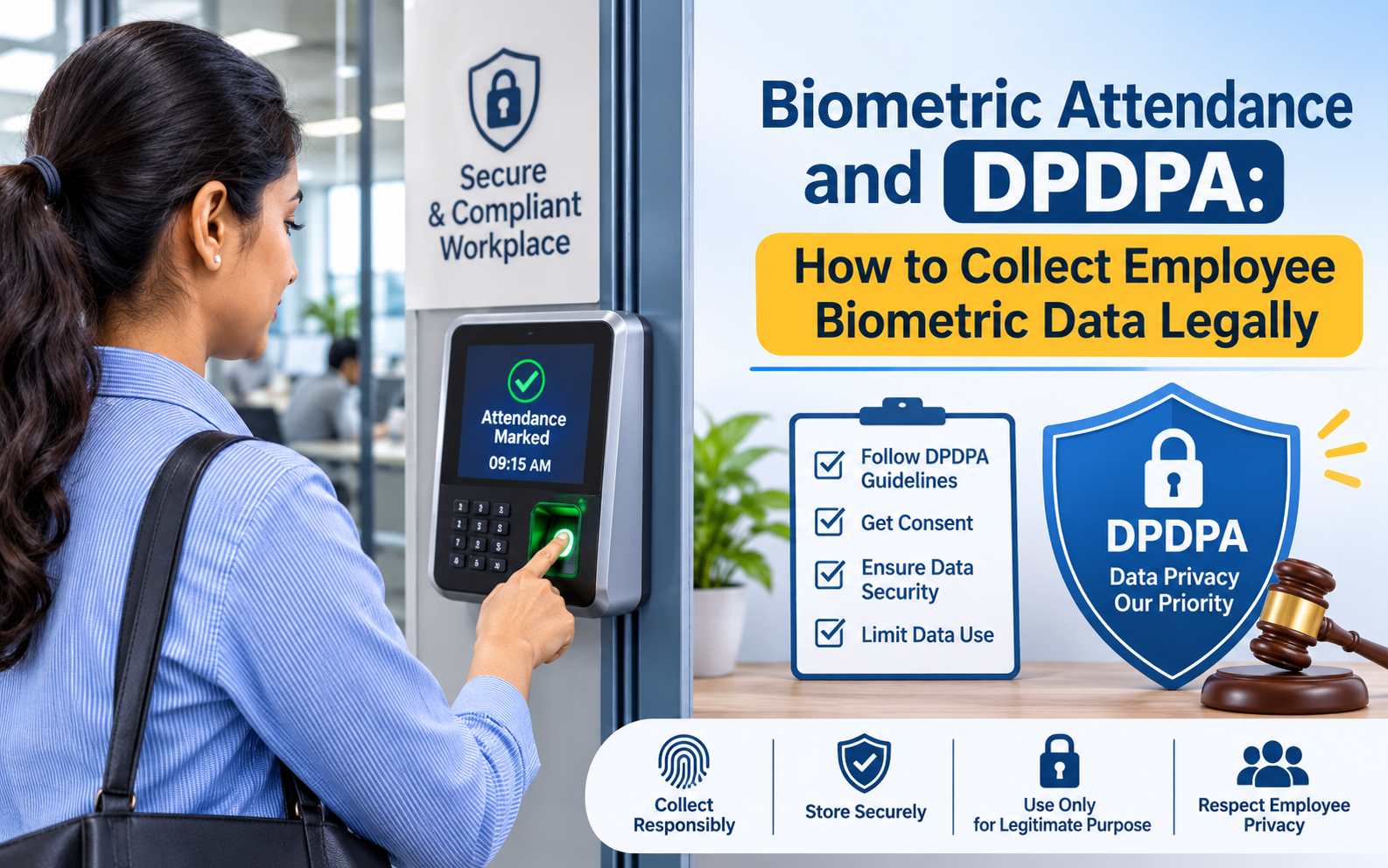
Learn how to collect employee biometric data under DPDPA. A practical compliance guide covering consent, storage, retention, and employer duties.
Introduction: Your Biometric Attendance System May Already Be Breaking the Law
Walk into most offices in Bangalore today, and you’ll see it: a sleek fingerprint scanner or facial recognition camera at the entrance, quietly logging who comes in and when. It feels modern. It feels efficient. But here’s the uncomfortable truth, most companies using biometric attendance and DPDPA compliance in the same sentence have never actually checked whether their system is legal.
Fingerprints, facial scans, and iris data are not ordinary employee records. Under India’s Digital Personal Data Protection Act, 2023 (DPDPA), they are treated as sensitive personal data that demands strict handling. With the Digital Personal Data Protection Rules, 2025 now notified and a compliance clock already ticking, employers can no longer treat biometric attendance as a “set it and forget it” HR tool.
This guide breaks down exactly what the law requires, where most companies go wrong, and how to fix your biometric attendance setup before it becomes a liability.
What Is DPDPA and Why Does It Apply to Biometric Attendance?
The Digital Personal Data Protection Act 2023 is India’s first comprehensive data protection law. It governs how organisations collect, store, and process the digital personal data of individuals, including employees.
Under the Act:
- Your company is the Data Fiduciary — the entity that decides why and how biometric data is collected.
- Your employee is the Data Principal — the individual whose fingerprint, face, or iris pattern is being captured.
- Biometric identifiers count as personal data because they can identify a specific person.
The Digital Personal Data Protection Rules, 2025 were notified on 13 November 2025, giving the Act real operational teeth. Phased compliance timelines mean most core obligations, notice, consent mechanics, and security safeguards, must be fully in place within 18 months, with the hardest deadlines falling around May 2027. That sounds far away. It isn’t, once you factor in system audits, vendor contracts, and policy rewrites.
Why Biometric Attendance Systems Carry Extra Risk
A payroll spreadsheet can be changed if it’s wrong. A password can be reset if it leaks. A fingerprint cannot. Once biometric attendance data protection fails, through a breach, a careless vendor, or an unsecured server, the employee has no way to “reset” their face or thumbprint. This is exactly why regulators and courts globally treat biometric authentication and data privacy as a higher-risk category than standard HR data.
Is Employee Consent Required for Biometric Data Collection?
This is the question every HR and compliance team asks first. The answer is layered.
The Section 7 Exemption, What It Does and Doesn’t Cover
DPDPA includes a provision (Section 7) that allows employers to process certain employee personal data without obtaining fresh consent for specific employment-related purposes, things like attendance tracking tied to safety, performance assessment, or preventing corporate espionage, provided the processing is necessary and proportionate.
Many employers misread this as a blanket free pass for biometric systems. It isn’t. The exemption is narrow and purpose-specific. It does not remove your obligation to:
- Clearly inform employees about what data is collected and why
- Limit collection to what’s genuinely necessary
- Secure the data properly
- Delete it when it’s no longer needed
Practical takeaway: Even where the exemption may technically apply, employee consent for biometric data remains the safer, more defensible path. A documented, informed, freely-given consent record protects your company if a Data Protection Board inquiry ever arrives.
What “Valid Consent” Actually Looks Like
For consent to hold up under DPDPA compliance for employee biometric data, it must be:
- Free — not bundled into an “accept or lose your job” ultimatum
- Specific — tied to the exact purpose (attendance tracking, not general surveillance)
- Informed — backed by a clear, standalone privacy notice, not buried in a 40-page HR manual
- Unambiguous — captured through an affirmative action, not assumed from silence
- Withdrawable — employees must be able to revoke it later, with a clear fallback attendance method offered
If your current system enrols every new hire’s fingerprint on day one as a standard onboarding step with no opt-out, you have a compliance gap worth fixing now.
Employer Responsibilities Under DPDPA for Biometric Systems
Think of employer responsibilities under DPDPA as a lifecycle, not a one-time checkbox.
1. Collection: Minimise What You Capture
Data minimisation is a core DPDPA principle. Ask: do you need a full facial template, or would a simpler access-card system achieve the same result? If biometric attendance is genuinely necessary (large campuses, high-security manufacturing floors, BFSI data centres), document why less intrusive alternatives were ruled out.
2. Notice: Tell Employees in Plain Language
Before enrolment, provide a standalone notice covering:
- What biometric data is collected (fingerprint, face geometry, iris)
- Why it’s collected (attendance, access control, safety)
- How long it will be retained
- Who can access it internally and externally (including any vendor)
- How to raise a grievance or withdraw consent
3. Storage: Secure Biometric Data Storage Is Non-Negotiable
Secure biometric data storage typically involves:
- Encrypting biometric templates at rest and in transit (AES-256 or equivalent)
- Storing mathematical templates rather than raw images wherever possible
- Role-based access controls so only authorised HR/IT staff can view records
- Regular security audits and penetration testing
- Keeping biometric data segregated from general HR databases
4. Retention: Don’t Keep It Forever
Under the DPDP Rules, 2025, data should be retained only as long as necessary for the stated purpose. A fingerprint collected for attendance tracking should be purged, not archived indefinitely, once an employee exits the organisation or the purpose no longer applies. A documented biometric data retention policy with automatic deletion triggers is one of the simplest ways to reduce long-term risk.
5. Breach Readiness: Plan Before It Happens
Personal data breach response under DPDPA requires fast, structured action, notifying the Data Protection Board and affected individuals, containing the incident, and documenting the root cause. Employee data breach prevention starts with the measures above, but every organisation should also have an incident response plan specifically covering biometric records, since these breaches carry reputational and legal weight far beyond a typical data leak.
Step-by-Step: How to Make Your Biometric Attendance System DPDPA-Compliant
- Audit your current system — map what biometric data you collect, where it’s stored, who has access, and which vendor manages it.
- Rewrite your consent and notice flow — standalone, plain-language, specific to biometric collection.
- Offer a non-biometric alternative — card-based or PIN-based attendance for employees who decline, so consent is genuinely free.
- Encrypt and segregate biometric data — never store it alongside general employee files.
- Set a retention and deletion schedule — tie it to employment status and purpose.
- Review vendor contracts — ensure your attendance system provider is contractually bound to DPDPA-equivalent security and deletion obligations.
- Train HR and IT teams — they are your first line of defence against accidental non-compliance.
- Document everything — consent records, notices, and security measures are your evidence if questioned.
Who Needs to Act on This Now?
Workplace biometric data privacy isn’t a niche concern, it touches nearly every sector:
- BFSI and healthcare organisations, which already handle sensitive data and face the highest regulatory scrutiny
- Manufacturing companies using biometric attendance across large, shift-based workforces
- IT and SaaS companies with distributed, hybrid teams and multiple office access points
- Universities and research institutions managing staff and visiting researcher access
- Renewable energy and AI/ML companies operating secure facilities where biometric access control is standard
If your organisation falls into any of these categories, DPDPA compliance for HR departments should already be on your 2026 roadmap, not a 2027 scramble.
How Gigahertz Consultants Helps You Stay Compliant
Getting biometric attendance and DPDPA right isn’t just a legal exercise, it’s a technical one. At Gigahertz Consultants, we help medium and large enterprises, SMEs, and specialised sectors like BFSI, healthcare, and manufacturing build IT infrastructure and compliance frameworks that hold up under scrutiny.
That includes secure data storage architecture, encryption strategy, access control systems, and practical compliance roadmaps tailored to how your business actually operates, not generic templates that fall apart under real-world conditions. If you’re already working on broader data protection, our guide on how to achieve DPDPA compliance without disrupting your operations is a useful next read, and our breach response checklist for IT teams pairs well with the storage safeguards discussed above.
FAQs
1. Is biometric attendance legal in India under DPDPA?
Yes, it’s legal, but only when employers follow DPDPA rules for employee data: clear notice, lawful basis for processing (consent or the limited Section 7 exemption), secure storage, and a defined retention period.
2. Can an employer collect fingerprints without employee consent?
In narrow, purpose-specific circumstances, Section 7 may allow processing without fresh consent. However, obtaining clear, informed consent is strongly recommended for biometric data specifically, given its sensitivity and irreversibility.
3. How long can a company keep employee biometric data?
Only as long as it serves the stated purpose. Best practice is to delete biometric records promptly after an employee exits or the attendance system purpose ends, as outlined under Rule 8 of the DPDP Rules, 2025.
4. What happens if a company doesn’t comply with DPDPA for biometric data?
Non-compliance can lead to significant financial penalties, reports indicate fines can reach up to Rs. 250 crore per violation under the Act, alongside reputational damage and potential legal action from affected employees.
5. Do small businesses need to comply with DPDPA too?
Yes. DPDPA compliance for businesses applies regardless of size if you process personal data, including employee biometric data. SMEs using biometric attendance systems are just as accountable as large enterprises.
6. What’s the difference between facial recognition and fingerprint attendance privacy risks?
Facial recognition attendance data protection carries added risk because facial data can potentially be captured passively (via cameras) without direct interaction, raising additional consent and purpose-limitation questions compared to fingerprint systems, which require active employee participation.
Conclusion: Don’t Wait for an Audit to Fix Your Biometric Attendance System
Biometric attendance and DPDPA compliance isn’t about ticking a legal box, it’s about protecting data that, once compromised, can never truly be reset. The organisations that act now, with clear consent processes, secure storage, and defined retention policies, will be the ones unaffected when enforcement tightens.
Don’t leave your employee biometric data protection to chance. Get in touch with Gigahertz Consultants today to audit your systems and build a compliance framework that actually works.
Office: 080-4128-7587 | Email: reachus@gigahertzconsultants.com
716, 1st Floor, 3rd Main, 9th Cross, Doctor Modi Hospital Road, Chord Rd, near Ganesh Temple, 2nd Stage, Bengaluru, Karnataka 560010, Open Maps
Category: SCADA